
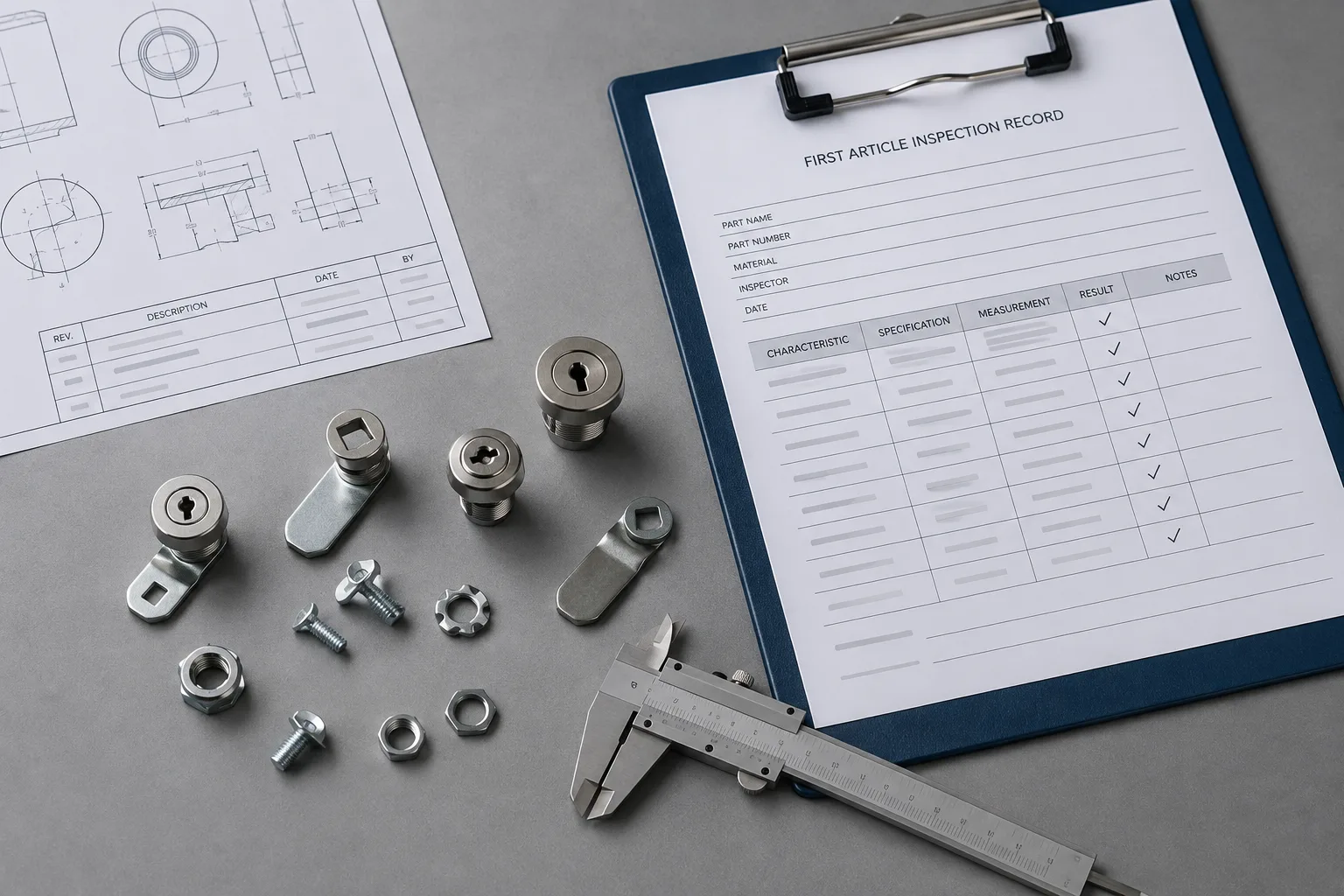
A lock sample can look acceptable and still leave the production team with an unclear release decision. A useful first article inspection record connects one identified item to the exact drawing, purchase requirement, approved references, inspection results, open issues, and named decision authority.
This buyer-side template is for procurement, supplier-quality, engineering, and program teams managing cabinet, drawer, mailbox, locker, or enclosure lock orders. It helps the team decide whether a new or changed production setup may proceed, needs correction, or requires more evidence. It does not supply project tolerances, test methods, or acceptance limits; those must come from the buyer’s approved requirements.
Quick Answer
A lock first article inspection record should identify the part and production context, freeze the applicable document revisions, list each inspection characteristic and its acceptance source, record actual evidence, separate open issues from accepted deviations, and end with an explicit production-release decision. Approval of one first article is not proof that every later unit will conform, so the record must also hand the approved baseline to the production and ongoing quality-control process.
What First Article Inspection Means
The American Society for Quality describes first article inspection (FAI) as a documented physical and functional inspection used to verify that prescribed production methods produced an acceptable item against requirements such as drawings, planning, purchase orders, and engineering specifications. The definition appears in the ASQ Certified Supplier Quality Professional Handbook sampler.
That description is useful because it separates FAI from three nearby activities:
- Prototype review asks whether a design direction is workable.
- First article inspection asks whether an identified production result conforms to the released requirements.
- Lot or shipment inspection asks whether the broader production output meets the agreed acceptance plan.
FAI is formalized in some sectors. For example, the International Aerospace Quality Group states that its 9102 standard provides consistent FAI process and documentation requirements for aviation, space, and defense products. The buyer template below is not an AS9102 form and does not imply aerospace compliance. If a contract names a standard, customer form, or regulatory procedure, use that controlled requirement instead.
When Should a Lock Program Open an FAI Record?
Do not trigger or waive FAI from memory. Define the program’s trigger rules in the purchase specification, quality agreement, or release plan. The following matrix is an editable decision aid, not a universal requirement.
| Program event | Buyer question | Possible record action |
|---|---|---|
| New lock part or assembly | Has production produced this released configuration before? | Consider a full characteristic review. |
| Drawing or specification revision | Which characteristics or interfaces changed? | Review affected characteristics and any connected risks. |
| Material, component, tooling, process, or site change | Could the change affect form, fit, function, appearance, packaging, or traceability? | Define a full or partial reinspection scope. |
| Long production interruption | Does the contract or control plan require renewed evidence? | Apply the buyer’s documented restart rule. |
| Corrective action with a process change | What evidence is needed before the changed process is released? | Link the FAI record to the corrective-action record. |
| No relevant change | Is current approval still valid for this exact revision and source? | Record the basis for no new FAI if the buyer’s procedure permits it. |
A partial review is not simply a shorter full review. State why it is partial, identify the changed and potentially affected characteristics, and link the earlier accepted baseline. If the impact cannot be bounded, the decision owner should expand the scope rather than guess.
Freeze the Inspection Baseline Before Checking the Part
The inspection has little value if the team cannot tell which requirements applied. Before recording results, list the controlled references used for comparison:
- Buyer part number and supplier part number
- Assembly or product configuration
- Drawing number and revision
- Purchase order and line item
- Approved sample, finish reference, artwork, label, or packaging revision when applicable
- Inspection plan, test method, or customer form required by the contract
- Approved deviation references that remain valid for this release
Mark a missing or conflicting reference as an open issue. Do not silently choose the newest-looking file. A document list also makes the next change review easier because the team can compare revisions instead of reconstructing the baseline from email.
If the team is still deciding whether the design can be manufactured, return to the DFM review for custom cabinet and cam locks. FAI should verify released requirements; it should not become an informal design meeting.
Identify the First Article and Its Production Context
The record should make the inspected item traceable without exposing sensitive access data. Capture the sample or unit identifier, quantity presented, date, manufacturing location, line or work-center reference where relevant, production order or lot reference, and the process state represented.
Also state whether the item came from intended production tooling, materials, components, operators, and process flow. If it did not, describe the limitation and decide whether the item is a prototype, a preliminary check, or valid first-article evidence under the buyer’s procedure.
Keep key-cut data, credential lists, access hierarchies, and other security-sensitive information in the authorized project channel. The public-facing record may reference a controlled key-system or credential document by ID without reproducing its contents.
Build a Characteristic-by-Characteristic Evidence Table
Do not use one overall checkbox for the whole lock. Break the review into characteristics that can be traced to a requirement and an inspection result. The exact characteristics depend on the released design.
| Characteristic group | Possible buyer evidence | Question the record must answer |
|---|---|---|
| Identity and configuration | Part number, revision, component list, photographs | Is this the exact configuration submitted for approval? |
| Mounting interface | Released drawing and recorded inspection result | Does the result meet the buyer’s stated requirement? |
| Assembly and orientation | Assembly record, approved configuration, visual evidence | Are required components present and oriented correctly? |
| Operation | Buyer-approved functional method and result | Was the required function checked by the specified method? |
| Appearance and finish | Approved visual reference, finish specification, photographs | Was comparison made to a controlled reference? |
| Marking and traceability | Artwork or label revision, lot or source record | Can the item and its evidence be traced to the correct order? |
| Accessories and pack-out | Approved bill of contents and packaging revision | Does the submitted configuration include the required items? |
| Project-specific tests | Named procedure and attached report | Is the method, result, and acceptance authority documented? |
For each row, record the characteristic number, requirement source and revision, required criterion, inspection or test method, actual result, pass/fail/not-applicable status, evidence filename or record ID, inspector, and date. Use actual results where the method produces them; avoid replacing evidence with “looks good” or “same as sample.”
The ASQ definition makes the connection to drawings, planning, purchase orders, and engineering specifications explicit. That is why each result should point back to its acceptance source rather than rely on an undocumented expectation.
Separate Discrepancies, Deviations, and Corrections
A failed or unclear characteristic should remain visible. Record what was found, the affected characteristic, evidence, owner, containment or next action, and due date. Then route it to the appropriate process:
- Correction and resubmission: the supplier corrects the issue and presents a new identified article or new evidence.
- Deviation review: the buyer’s authorized decision owner evaluates a bounded exception using a separate lock order deviation request.
- Requirement correction: engineering resolves a wrong, incomplete, or conflicting controlled requirement.
- Corrective action: a systemic quality issue is managed through the supplier corrective action record.
Do not convert a failed result into a pass merely because a deviation is being discussed. Keep the inspection result and the disposition decision as separate facts.
Use Clear Release Statuses
The record should end with one status whose scope is unmistakable. Adapt the labels to the buyer’s quality system.
| Status | Meaning | Production action |
|---|---|---|
| Approved | Required evidence is accepted for the stated part, revision, source, and scope. | Proceed only within the approved release boundary. |
| Approved with conditions | Named conditions are accepted by authorized owners and do not leave an unresolved release gate. | Proceed only after conditions and responsibilities are documented. |
| Revise and resubmit | Correction or missing evidence prevents approval. | Do not treat the current article as the production baseline. |
| Rejected | The submitted article does not meet the release requirements. | Stop release and follow the agreed disposition process. |
| Cancelled or superseded | The record no longer governs because the configuration or request changed. | Reference the replacement record if work continues. |
“Approved with conditions” should not become a holding area for unresolved safety, compliance, fit, function, or customer-mandated evidence. Define non-negotiable gates separately so an overall judgment cannot conceal a missing critical approval.
Copyable Lock FAI Record
Copy these fields into the buyer’s controlled quality form. Add or remove fields to match the contract and product risk.
1. Record control
- FAI record ID; full or partial review; reason for review
- Buyer organization and program; supplier and manufacturing location
- Buyer part number; supplier part number; part name; configuration
- Purchase order and line; production order or lot; sample or unit IDs; quantity presented
- Submission date; inspection date; planned release date
2. Applicable baseline
- Drawing number and revision
- Specification, inspection plan, and test-method references
- Approved sample, finish, artwork, label, and packaging references
- Bill of materials or approved component-list revision where required
- Active deviation references and their scope
3. Production context
- Manufacturing source, line or work center, tooling reference, and process revision as required
- Statement of whether intended production materials, components, tooling, and process were used
- Known limitations or differences from planned production
4. Characteristic results
- Characteristic number and description
- Requirement source, criterion, and method
- Actual result and unit where applicable
- Status: pass, fail, not applicable, or not inspected
- Evidence reference, inspector, and date
5. Open items and disposition
- Issue ID, affected characteristic, description, and evidence
- Correction, deviation, requirement clarification, or corrective-action route
- Owner, due date, closure evidence, and closure authority
6. Decision
- Final status and exact release scope
- Conditions, exclusions, and required follow-up
- Supplier representative; buyer quality reviewer; engineering or program approver as required
- Names, roles, dates, and controlled approvals
- Approved reference storage location and supersession rule
Hand the Accepted Baseline to Production and QC
After approval, distribute the same controlled references to purchasing, supplier production, incoming inspection, pre-shipment inspection, assembly, and after-sales teams that need them. Do not rely on the physical article alone; samples can be damaged, mislabeled, or separated from their governing revisions.
The ongoing lock quality control checklist should use the released specification, approved evidence, and inspection plan. If a later order proposes a change to that baseline, open a repeat-order change-control review rather than editing the old FAI record.
Approval is limited to the stated part, revision, source, and conditions. It does not automatically approve another lock family, finish, key-system configuration, manufacturing location, or later engineering change.
Common Record Failures
- No revision lock: results cannot be tied to the exact drawing and specification used.
- One overall pass box: failed, missing, and not-applicable characteristics disappear inside a summary.
- Photos without IDs: images cannot be matched reliably to the inspected article or issue.
- Approval mixed with deviation: a nonconforming result is relabeled instead of separately authorized.
- Prototype presented as production evidence: the article does not represent the intended production context.
- No release boundary: approval is incorrectly reused for another revision, source, or configuration.
- Sensitive access data copied broadly: key or credential information is distributed outside the authorized channel.
What to Send for a Supplier Review
For a lock-program review, send the application, part and drawing revisions, mounting interface, configuration, approved references, inspection requirements, sample or first-article objective, quantity and timing, packaging requirements, and the names of the people authorized to resolve technical questions and approve release.
Send these project inputs through the WELLHW contact page for a standard-model or specification-driven review. Keep controlled drawings and security-sensitive key or credential data in the agreed authorized channel.
Frequently Asked Questions
Is a first article the same as a golden sample?
Not necessarily. A first article is an identified production result inspected against released requirements. A retained or “golden” sample may serve as a controlled visual or physical reference, but it should not replace drawings, specifications, inspection records, or required test evidence.
Does first article approval release the whole production lot?
Only if the buyer’s documented procedure and authorized decision explicitly say so. FAI verifies the submitted article and production context; ongoing process controls and lot or shipment acceptance remain separate.
What if one characteristic cannot be inspected?
Mark it as not inspected, state why, and route the missing evidence to the decision owner. Do not record a pass without the required evidence.
Should a changed finish or packaging revision trigger a new FAI?
Use the buyer’s documented trigger rules and risk assessment. The review may be full or limited to affected and connected characteristics, but the scope and rationale should be recorded.
Can WELLHW’s template replace a customer-mandated FAI form?
No. This is an editable buyer-side planning tool. A contract, customer-specific form, applicable standard, or regulatory procedure takes priority.
