
A custom lock project can reach production with the product drawing under control while the tooling record remains fragmented across quotations, purchase orders, supplier messages, and maintenance notes. A custom lock tooling record gives procurement, engineering, quality, and the supplier one controlled index for identifying each tool, locating the commercial evidence, recording custody and condition, approving changes, and planning transfer or retirement.
This buyer-side template applies to project-specific molds, stamping dies, fixtures, jigs, gauges, assembly aids, and similar production assets used for cabinet, drawer, mailbox, locker, or enclosure lock programs. It does not decide legal ownership, prescribe a maintenance interval, or claim that every project requires dedicated tooling. Those decisions must come from the applicable contract, purchase documents, tool design, service conditions, and authorized project owners.
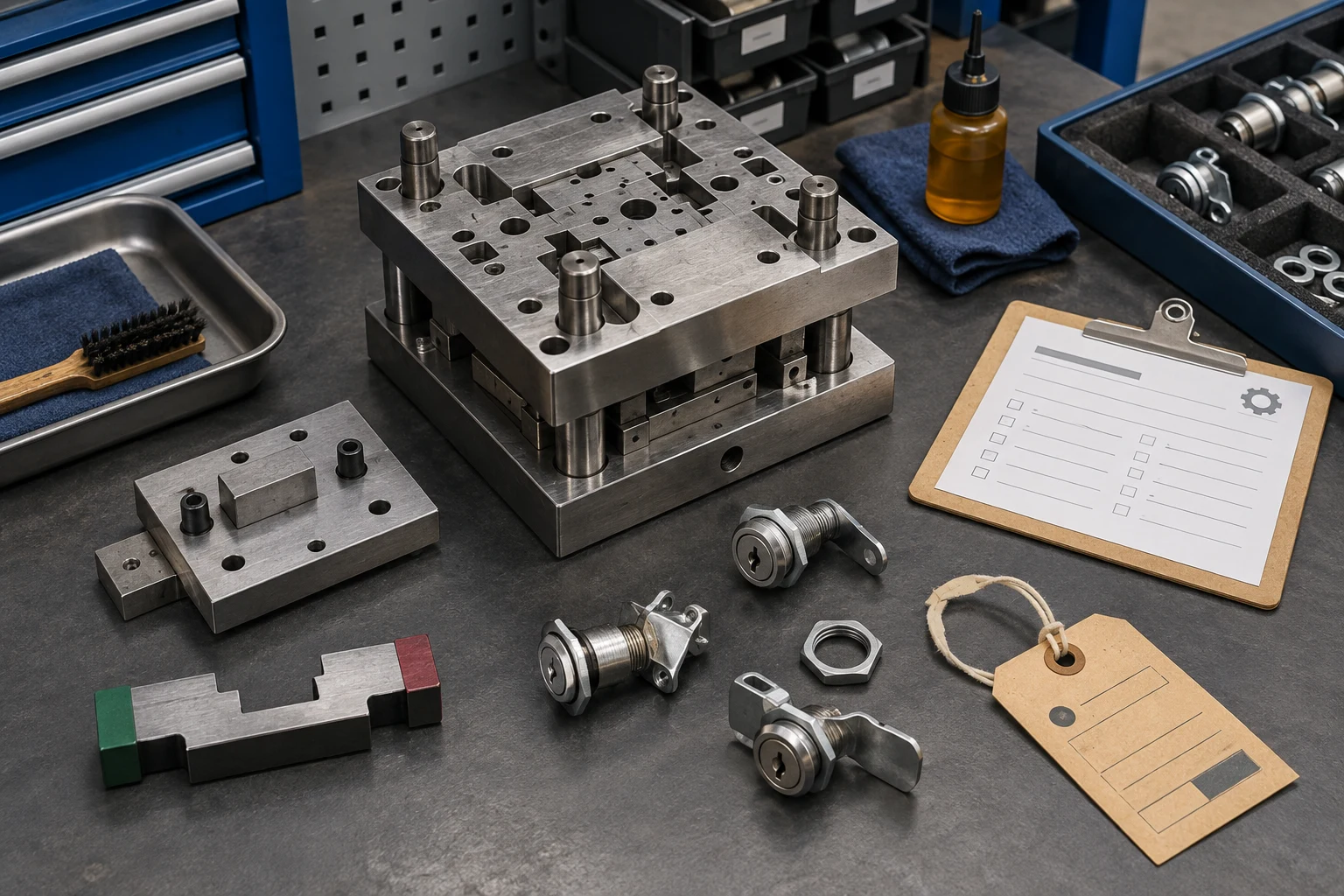
Quick Answer: What Should the Tooling Record Control?
The record should identify every controlled asset, the product or feature it supports, the agreement or purchase reference that governs it, the named owner and physical custodian, its location, status, revision, condition, maintenance history, approved changes, linked production or inspection evidence, access restrictions, transfer conditions, and final disposition. It should also separate facts that are often blurred together: who has contractual title, who physically holds the tool, and who may authorize its use or modification.
Separate Ownership, Custody, and Production Authorization
A tool label or a supplier inventory line does not by itself settle ownership. Likewise, possession of a tool does not automatically authorize a supplier to modify it, use it for another project, move it to another facility, or release production from it. The record should point to the controlling commercial documents rather than attempting to replace them.
| Control question | What the record should show | What it should not assume |
|---|---|---|
| Who owns it? | Named party and the contract, PO, invoice, amortization agreement, or other approved basis | That payment, possession, an asset tag, or a quotation automatically proves title |
| Who holds it? | Supplier, site, building or storage area, custodian, and last verification date | That the commercial owner physically controls the asset |
| Who may use it? | Approved product family, part or feature, site, supplier, and release status | That an available tool may be used for any order or customer |
| Who may change it? | Required reviewers, change record, approval date, resulting revision, and validation evidence | That routine maintenance permits a geometry or functional change |
Ownership and transfer terms can have legal and tax consequences. Use qualified commercial or legal review where the governing agreement requires it. This article provides a record structure, not a conclusion about title or enforceability.
Define What Counts as a Controlled Tooling Asset
Start with a project rule for what enters the register. A single “mold” line may be too broad when inserts, slides, electrodes, nests, checking fixtures, and spare components can be changed or moved independently. Conversely, recording every standard hand tool would make the register unmanageable.
Common candidates include injection or die-casting molds, stamping and forming dies, punches and inserts, machining fixtures, assembly nests, drilling or staking jigs, dedicated checking fixtures, master setting pieces, go/no-go gauges, marking fixtures, and project-specific test adapters. Standard supplier equipment can be referenced without being represented as buyer-owned tooling.
Open the Record Before Tooling Is Ordered
The best time to create the record is when commercial and technical requirements are still being agreed, not after a tool becomes difficult to identify. During quotation and purchase review, assign a provisional asset ID and list unresolved items such as ownership basis, payment milestone, storage term, maintenance responsibility, permitted use, insurance, access, transfer, and end-of-program disposition.
Connect the record to the lock DFM review, but keep the purposes separate. DFM evaluates whether the design and process approach are ready for development. The tooling record controls the assets and decisions that remain after the technical route is selected.
Build a Tooling Asset Identification Hierarchy
Give each independently controlled asset a stable ID. Record the supplier’s identifier as a cross-reference rather than making it the only identity. If a mold contains replaceable inserts or a die set contains controlled stations, use a parent-child relationship so the team can see which component changed without losing the main tool history.
| Identity field | Why it matters | Useful evidence |
|---|---|---|
| Buyer asset ID | Keeps the identity stable across suppliers, locations, and document revisions | Register entry and durable asset tag where appropriate |
| Supplier tool ID | Connects the buyer’s record to local storage and maintenance systems | Supplier register, label, and photographs |
| Parent and child IDs | Separates a base tool from controlled inserts, nests, or stations | Asset tree or indexed parts list |
| Product relationship | Shows the part, feature, variant, or operation supported by the tool | Drawing reference, operation number, or approved tooling list |
| Revision and status | Prevents obsolete or unapproved tooling from appearing current | Change log, approval record, and status label |
| Visual identity | Helps a remote reviewer reconcile the record with the physical asset | Overall, tag, working-area, and storage-condition photographs |
Link the Commercial Basis Without Rewriting the Contract
For each asset, cite the exact document and clause or line item that addresses ownership, payment, amortization, custody, maintenance, permitted use, access, transfer, storage, and disposition. Mark an item “not found” or “open” when the basis is missing; do not fill the gap with an assumption.
The record can link quotation, purchase order, tooling invoice, acceptance milestone, amortization schedule, confidentiality terms, and any separate tooling agreement. The supplier-document guide can help organize the broader controlled file package before bulk production.
Record Custody and Location as Verifiable Facts
Custody should be specific enough to support a physical check. Record the legal supplier name, manufacturing site, sub-tier location when authorized and applicable, storage area, custodian, and date last verified. If the tool moves, preserve the old location in a movement log instead of overwriting it.
A useful location verification includes photographs of the asset and tag, storage condition, preservation method when specified, and any separated components. Do not expose proprietary drawings, key codes, access credentials, or facility-security details in a broadly shared record.
Use Statuses That Control What May Happen Next
| Status | Meaning | Allowed next action |
|---|---|---|
| Proposed | Asset need and scope are being defined | Complete commercial and technical review |
| Ordered / under construction | Authorized work has begun, but the asset is not released for production | Track milestones and evidence |
| Trial use | The asset may be used only for the identified development or validation scope | Generate the required sample and inspection evidence |
| Approved for defined production | The identified revision is released for the recorded products, site, and order boundary | Use only within that boundary |
| Maintenance hold | Condition or evidence requires review before further use | Maintain, repair, inspect, and obtain release |
| Change hold | A proposed or detected change is not yet approved | Complete change review and any required validation |
| Inactive / stored | The asset is retained but not currently authorized for production | Apply the agreed preservation and verification plan |
| Transferred, retired, or disposed | Custody or lifecycle has formally changed | Close quantities, components, evidence, and approvals |
Design the Maintenance Record Around Evidence, Not a Generic Interval
Do not copy a maintenance frequency from another tool simply because the tools look similar. The responsible team should set triggers from the tool design, material and process, supplier instructions, usage history, condition, product risk, and contractual requirements. Record the basis for the selected trigger.
The maintenance log should capture date, tool ID and revision, reason or trigger, observed condition, work performed, parts replaced, person or organization performing the work, inspection result, open issues, and release decision. Where counters or usage records exist, state what the count represents rather than writing an unexplained number.
Maintenance evidence line
Tool ID: ____ Revision: ____ Date: ____
Trigger and basis: ____
Condition before work: ____
Maintenance or repair performed: ____
Components replaced or adjusted: ____
Inspection / trial evidence: ____
Result: released / restricted / hold
Approver and date: ____
Keep Maintenance and Tooling Changes Separate
Cleaning, lubrication, or replacement with an approved equivalent component may be maintenance under the project’s rules. A geometry change, insert revision, process relocation, material substitution, cavity change, or altered working condition may require formal change approval. The record should define the boundary rather than relying on what the supplier informally calls a repair.
Rockwell Automation’s supplier quality manual, for example, requires written notification and approval for defined supplier changes that include tooling and manufacturing-process changes. HARMAN’s supplier quality manual similarly describes advance information expected for proposed changes. These are customer-specific examples, not universal requirements. Apply the notification and approval rules in the buyer’s own agreement. Use the repeat-order change-control checklist when a tooling change could alter a future order baseline.
Connect the Tool Revision to Product Evidence
A tooling record should not declare product conformity by itself. After construction, repair, relocation, or an approved change, link the tool revision to the sample, inspection, capability, or other evidence required by the project. State the exact scope reviewed and the authority that released it.
The first article inspection record is the appropriate place to compare an identified first article with controlled requirements. The tooling register should reference that evidence and preserve the connection between the released tool revision and the product or operation it supports.
Control Access, Transfer, and End-of-Program Decisions
Before a transfer is needed, record who can request access, what notice and evidence are required, which components and records are included, how condition will be established, and who approves movement. Do not assume a transfer can occur merely because the register names an owner.
At program close, choose and document the authorized disposition: continued storage, transfer, sale, return, conversion, retirement, or disposal. Reconcile the main tool and every controlled child component. Record final photographs, condition, outstanding charges or obligations where applicable, receiving evidence, and approval. Legal, customs, tax, confidentiality, and environmental requirements must be handled by the responsible specialists for the actual transaction.
Copyable Custom Lock Tooling Record
1. Project and asset identity
Project / buyer: ____
Supplier / manufacturing site: ____
Buyer asset ID / supplier tool ID: ____
Parent / child relationship: ____
Tool type and purpose: ____
Product, feature, or operation supported: ____
Drawing / specification / process reference: ____
2. Commercial control
Recorded owner: ____
Ownership basis and document reference: ____
Payment or amortization reference: ____
Permitted product / site / use boundary: ____
Maintenance responsibility: ____
Storage, access, transfer, and disposition references: ____
Open commercial items and owner: ____
3. Custody and physical verification
Physical custodian: ____
Current location: ____
Asset-tag reference: ____
Main and child components present: ____
Condition / preservation status: ____
Photo or inspection evidence: ____
Verification date and verifier: ____
4. Revision and release
Current tooling revision: ____
Status: ____
Approved product / order / site boundary: ____
Trial or inspection evidence: ____
Open restrictions: ____
Release approver and date: ____
5. Maintenance and change history
Maintenance plan / trigger basis: ____
Last maintenance record: ____
Current condition: ____
Change / repair ID: ____
Resulting revision: ____
Revalidation evidence and decision: ____
6. Movement or lifecycle close
Requested action: store / transfer / retire / dispose / other ____
Included tools, inserts, gauges, spares, and records: ____
Condition and quantity reconciliation: ____
Sending and receiving evidence: ____
Conditions or open obligations: ____
Final approver and date: ____
Common Record Failures to Prevent
- One line for an entire tool family: inserts, gauges, and spare components cannot be traced independently.
- Ownership shown without evidence: the register states a party but cites no controlling document.
- Location overwritten: movement history and responsibility disappear.
- Maintenance treated as approval: completing work is mistaken for authorization to resume production.
- Repair hides a change: a functional or geometry change bypasses the project’s review process.
- Tool revision disconnected from product evidence: the team cannot determine which revision produced an approved sample or lot.
- End-of-program action left informal: components, records, or obligations remain unresolved.
What to Send for a Tooling-Control Review
Send the product or feature reference, proposed tool list, buyer and supplier asset identifiers, quotation and PO references, ownership and payment terms, permitted-use boundary, manufacturing and storage locations, maintenance responsibility, required change-notification path, sample or inspection expectations, transfer conditions, and named approvers. Mark missing terms as open instead of letting the supplier infer them.
For a project-specific review, send WELLHW the non-confidential lock drawing or product reference, expected customization, order stage, proposed tooling list, and the commercial and technical questions your team needs resolved through the contact page. WELLHW can review the supplied project inputs and identify what must be clarified before a tooling proposal or production-release decision; the applicable agreement remains the authority for ownership and transfer terms.
