
By Andrew · Prepared with AI assistance.
A lock order receiving discrepancy record connects a delivery difference to the exact order line, physical stock, evidence, responsible owner, and next decision. Use it when a lock shipment arrives short, contains an unexpected item, has inconsistent labels, or needs further review before stock can be accepted.
This buyer-side template is for procurement, warehouse, inventory, and supplier-quality teams handling cabinet, drawer, mailbox, locker, furniture, and enclosure lock orders. It helps document what arrived and what remains unresolved. Apply your approved receiving and inspection requirements; this article does not set product acceptance criteria or determine supplier or carrier responsibility.
Define This Receipt Before Comparing Quantities
A purchase order can cover several deliveries. Compare the goods that arrived with the quantity expected for this particular shipment, then reconcile the remaining order balance separately. Otherwise, a planned later delivery can be reported as a shortage, or a real short receipt can disappear inside an open order.
Give the receipt its own reference. Connect it to the purchase order and line, supplier delivery reference, receiving date and location, item code, recorded revision or variant, lot reference, carton identifiers, and unit of count. For cabinet lock orders, keep separately ordered lock bodies, cams, fasteners, and accessory packs on their applicable lines. Do not count a carton, a loose component, and a complete set as the same unit.
Compare the supplier’s pre-shipment release record with the delivery evidence when available. Keep both records: the earlier dispatch decision and the later receipt observation describe different events.
Separate Expected, Received, and Accepted Quantities
Write down the count basis and the extent of the check. A carton-label total is not a completed piece count. If only part of a receipt has been checked, show the checked scope and keep the remaining quantity visibly unresolved.
| Field | What it records | Next question |
|---|---|---|
| Expected for this receipt | The quantity supported by the agreed shipment reference | Does the reference cover this delivery rather than the whole order? |
| Physically received | What was counted, with method and checked scope | Are pieces, sets, packs, and cartons clearly distinguished? |
| Accepted | Received quantity with a recorded acceptance decision | Who authorized that quantity and on which evidence? |
| Held or awaiting review | Received quantity still awaiting an applicable decision | Where is it, who owns the review, and what is missing? |
| Rejected, still on site | Received quantity assigned a rejection decision but not yet moved out | What authorized next action and location are recorded? |
| Not received | The unresolved difference against this receipt’s expected quantity | Is it confirmed short, separately shipped, or still under investigation? |
At a stated cutoff, assign each received unit to one stock-status bucket. For a receipt that has not had goods returned or transferred out, accepted plus held plus rejected-on-site quantities should reconcile to the physical quantity received. If movement has already occurred, add the movement references and reconcile the opening receipt to the remaining stock and recorded movements.
A unit can have several observations but only one stock status at the same cutoff. For example, a carton-label mismatch and missing documentation may affect the same ten units. Link both issues to those units without reporting twenty affected units. Do not offset a shortage on one item with an overage on another.
Describe the Observation Before Assigning a Cause
IBM’s receiving-discrepancy documentation illustrates fields for shipment, line, item, unit of measure, discrepancy type, and quantity. The table below adapts that record logic to a lock-order discussion; it is an editorial worksheet, not a required ERP format.
| Observation | Evidence to connect | Question for the owner |
|---|---|---|
| Count differs from the shipment record | Expected receipt reference, count sheet, unit basis, identified cartons, recount result | Is the difference a count error, split delivery, document error, or unresolved shortage? |
| Item or revision identification differs | Order line, approved identification reference, observed label, affected stock location | Can the identity be established from controlled records? |
| Loose parts or set contents appear incomplete | Agreed contents list, observed contents, checked scope, affected set references | Which complete sets and loose pieces are actually present? |
| Visible condition needs review | Dated observations, relevant photographs, packaging condition, affected quantity | Which authorized quality owner should assess the finding? |
| Required document cannot be matched | Required file reference, received revision, applicable lot or carton identifiers | Is the document missing, outdated, or for different goods? |
Write “outer carton torn; contents awaiting review” when that is all the evidence shows. Do not record “carrier damaged the locks” without support. Keep photographs connected to the receipt and affected stock, rather than leaving them as unidentified attachments. Use the packaging approval record to locate the agreed pack reference when a label or contents comparison is needed.
Track Stock Decisions and Follow-Up Separately
One overall “closed” box hides unfinished work. A supplier may acknowledge an issue while stock remains held; a replacement can arrive while the original goods still await return instructions. Use separate tracks so each owner sees the decision that remains open.
- Stock: awaiting review, held, accepted for a defined scope, rejected on site, or moved under a referenced instruction.
- Supplier follow-up: not yet raised, acknowledgment received, proposed resolution under review, agreed action pending, or action evidenced complete.
- Investigation: not required by the responsible owner, open, or closed under its own record.
Record the person, date, affected quantity, evidence, and authority behind each change. A receiving entry should not invent technical acceptance or approve a commercial remedy. Refer those decisions to the people authorized under the project arrangements.
If cause analysis or recurrence prevention is required, link a supplier corrective action record. Keep its investigation status separate from the immediate receipt resolution.
Copyable Lock Order Receiving Discrepancy Record
Adapt these fields to your system. Use record references instead of duplicating full technical or confidential files. ISO describes ISO 10013:2021 as guidance for developing and maintaining documented information suited to an organization’s needs; it does not prescribe this worksheet.
1. Receipt boundary
Receipt ID / discrepancy ID / revision: ____
Buyer site / supplier / receipt date: ____
Purchase order / line / delivery reference: ____
Item / revision or variant / lot / carton IDs: ____
Unit of count / checked scope / count method: ____
2. Quantity snapshot
Snapshot date and time: ____
Expected for this receipt / physically received: ____
Accepted / held / rejected on site: ____
Not received / unexpected overage: ____
Order balance planned for other deliveries: ____
Movements since receipt and reconciliation references: ____
3. Facts and evidence
Applicable requirement and reference: ____
Observed difference / affected quantity and identity: ____
Count sheet / photo / document references: ____
Known facts / unresolved questions: ____
Reporter / checker / date: ____
4. Stock decision
Current stock status and location: ____
Decision / covered quantity / exclusions: ____
Required quality review or other approval reference: ____
Authorized owner / decision date / next action: ____
5. Supplier follow-up
Notification reference / buyer owner / supplier contact: ____
Requested response / target date: ____
Agreed action and authority reference: ____
Replacement receipt / return movement / document correction reference: ____
Remaining quantity or action: ____
6. Closure
Stock reconciliation complete / evidence reference: ____
Agreed follow-up complete / evidence reference: ____
Linked investigation status and owner: ____
Open exclusions / next review date, if any: ____
Closure decision / authorized owner / date: ____
Store sensitive key identifiers, credential information, proprietary drawings, and customer-security data in authorized systems. A broadly shared discrepancy record usually needs the controlled reference and responsible owner, not the confidential contents.
Worked Example: A Partial Delivery With Held Stock
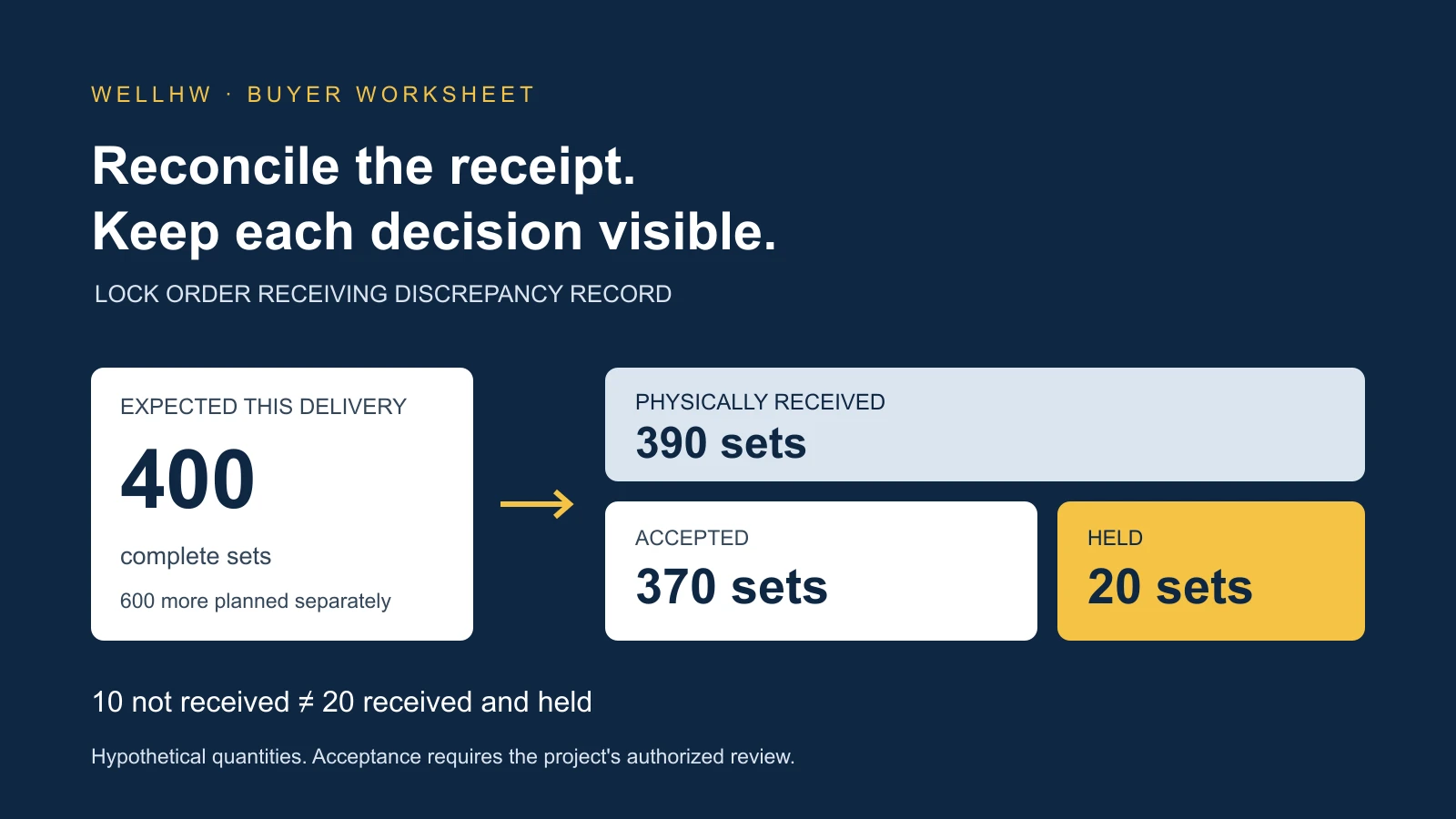
Hypothetical arithmetic only: a purchase order covers 1,000 complete lock sets. The agreed delivery split is 400 sets now and 600 later. The buyer counts 390 sets in the first receipt. After the required review, 370 have a recorded acceptance decision and 20 remain held because their identification is unresolved.
- Current delivery difference: 400 expected minus 390 received equals 10 sets not received.
- Received-stock reconciliation: 370 accepted plus 20 held equals 390 received.
- The later 600 sets remain a planned delivery, not part of this receipt’s ten-set difference.
- The 20 held sets are physically present. They must not also be counted as missing.
If ten additional sets arrive later, create a linked receipt and check what that delivery resolves. Do not silently change the original count from 390 to 400. Likewise, document any later decision on the 20 held sets against their own identity and evidence. This keeps the original observation, later arrival, and stock decision distinguishable.
Close the Case With Evidence Another Person Can Follow
Before closing, ask someone to follow the record from order line to receipt, affected stock, decision, movement, and agreed follow-up. The lock lot traceability record can supply the identity links without replacing the receipt decision.
Closure should identify what happened to each affected quantity, which agreed actions are evidenced complete, and who owns any separately open investigation. If a count is still uncertain, stock is still held, or an agreed action is unconfirmed, record the open item and next review instead of using an unexplained closure date.
For a WELLHW order question, use the contact details to provide the order and item references, receipt date, expected and observed quantities, redacted evidence, and the question that remains unresolved. Keep confidential access data out of general messages.
Prepared with AI assistance as an adaptable buyer record. The quantity example and worksheet are editorial tools, not a WELLHW customer case, operating procedure, or product acceptance standard.
