
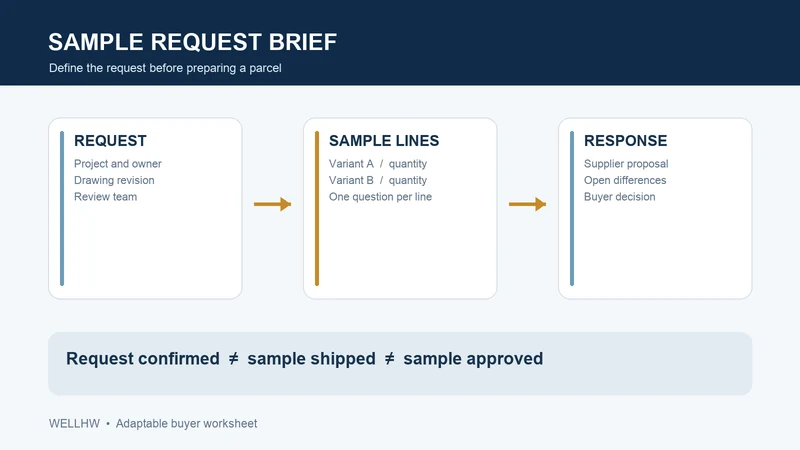
A lock sample request brief tells a supplier which version to prepare, why the buyer needs it, and which question the sample review must answer. For a cabinet, furniture, mailbox, locker, or enclosure program, write the brief before a parcel is arranged. Give each requested variant its own line, identify the drawing or specification revision, and name the buyer who can resolve an unclear request. A sample that arrives without this context may be physically present but impossible to evaluate against the intended project scope.
This is an adaptable buyer-side request tool. It does not set product requirements, promise that WELLHW offers a particular configuration, or replace the parties’ drawing, quotation, sample evaluation, or approval record. For dimensional inputs, use the existing cam lock dimension checklist; this brief controls the request and review assignment, not the engineering dimensions themselves.
Choose the Question Before Choosing the Quantity
Start with the decision the buyer intends to make. Is the team comparing catalog candidates, checking a proposed design against a project drawing, or reviewing a later sample revision after comments? These are editorial examples of request purposes, not formal industry stages. The purpose determines which evidence the reviewer needs and which earlier sample or document to compare. Avoid a request that says only “send samples”; it leaves the supplier to infer the item, version, and quantity.
For each line, record the application and buyer item reference, the supplier’s item reference if known, the requested sample ID or variant, the document revision, the quantity and unit, and a short review question. If the supplier reference is still unknown, mark it as an open question. Do not create a plausible code. If the request includes alternatives, keep their identities and questions separate even if they share a parcel later.
Public procurement examples show why these fields are useful without establishing a universal lock-industry rule. The Manatee County product evaluation form records a request number, product/model, evaluation method, supporting material, and sample quantity. An Amway pre-production sample assessment form pairs buyer and supplier references and asks what will differ between the sample and production. WELLHW does not claim to use either organization’s workflow; the brief below adapts the useful distinction between identity, intended review, and unresolved differences.
Keep the Request Header Separate From Sample Lines
The header identifies the project, request owner, supplier contact, request date, intended review team, and the document package being referenced. A line identifies one variant and one review question. This separation prevents a later revision for one item from silently changing every item in the same email.
| Level | Record | Decision it supports |
|---|---|---|
| Request | Request ID, project/application, buyer owner, supplier contact, issue date | Who can answer a scope question and which request is current? |
| Document package | Drawing/specification IDs and revisions; attachment or controlled link | Which written baseline is the sample meant to represent? |
| Sample line | Buyer and supplier item references, variant/sample ID, requested quantity and unit | Which physical items must be identified separately? |
| Review assignment | Purpose, one or more specific review questions, buyer reviewer and expected feedback route | What should the reviewer decide, and where will the answer be recorded? |
| Open difference | Unknown field, proposed substitution, owner, and buyer decision needed | What must be clarified before the supplier treats the line as confirmed? |
Write “unknown—buyer to confirm” where necessary. A missing attachment, unclear unit, or unagreed revision should remain visible as an open item. The buyer can ask the supplier to propose a reference, but a proposal is not the buyer’s accepted request until the named owner confirms it.
Decide How a Proposed Difference Will Be Handled
Ask the supplier to acknowledge each requested line with its proposed item reference, revision, quantity, and any difference from the brief. Keep the original request and the supplier’s response as separate records. If a different version, finish, accessory set, or quantity is proposed, record the change, the reason supplied, and the buyer’s decision. Do not overwrite the requested line so it appears that both parties agreed from the start.
A request may be sent, clarification open, supplier response received, or buyer scope confirmed. These are suggested administrative states, not product approval states. “Scope confirmed” means the parties know what sample is being prepared for review. It does not mean the sample has shipped, arrived, passed evaluation, or been approved for production. The sample dispatch and receipt record can later carry the confirmed line into parcel and physical-receipt tracking.
Fictional Example: Two Variants, One Open Clarification
Fictional administrative example. A buyer issues request SR-31 for a cabinet project. Line A asks for two units of sample A-03 against drawing D-8 revision C to review the buyer’s stated fit question. Line B asks for two units of sample B-01 against the same drawing to compare an alternative appearance specified by the buyer. The request lists the drawing link, the review owner, and where comments will be recorded. No actual dimension, product capability, or WELLHW customer is implied.
The supplier acknowledges two A-03 units but proposes B-02 for the second line. The record keeps B-01 as requested and B-02 as proposed. The buyer owner must decide whether B-02 answers the original comparison question, requires a revised brief, or should be declined. Until that decision is recorded, line B remains a clarification, even if line A can move forward. The example illustrates how one open line need not erase the status of another.
Copyable Lock Sample Request Brief
Copy the header once and repeat the line block for each variant. Attach the actual controlled drawing or specification where the project has one. Share sensitive access details, key codes, and personal delivery information only through the parties’ authorized channel.
Request header
Request ID / issue date / project and application ____
Buyer request owner and decision contact ____
Supplier response contact ____
Document IDs, revisions, and controlled attachment links ____
Intended review team and feedback record/location ____
Repeat for each sample line
Line ID / buyer item reference / supplier item reference if known ____
Requested sample ID or variant / revision / quantity and unit ____
Purpose and exact question this sample should answer ____
Earlier sample or document to compare, if relevant ____
Supplier acknowledged item, revision, and quantity ____
Any proposed difference and its reason ____
Buyer decision on the difference / decision owner / date ____
Current request state and next action ____
Before the supplier prepares or sends samples, have a second reader check that each line can be connected to a specific document revision and question, and that every supplier-proposed difference has a named buyer decision. This is an administrative completeness check, not a technical approval.
Carry the Request Into the Right Next Record
When the sample arrives and reviewers begin work, put their observations and responses in the sample feedback log. If a sample is later approved as a controlled reference, use the approved sample retention record. The request brief should stay attached to those later records by request ID and sample line; it should not be rewritten to imitate a later approval.
For a cabinet lock or other lock sample inquiry, send WELLHW the project application, buyer item reference, available drawing revision, requested variant and quantity, and the exact question each sample should answer. Identify any unknown reference or proposed alternative for review. Send the scoped sample request to WELLHW.
The request states, example, and worksheet are adaptable editorial tools. The parties’ approved project documents and authorized reviewers govern their actual decisions.
