
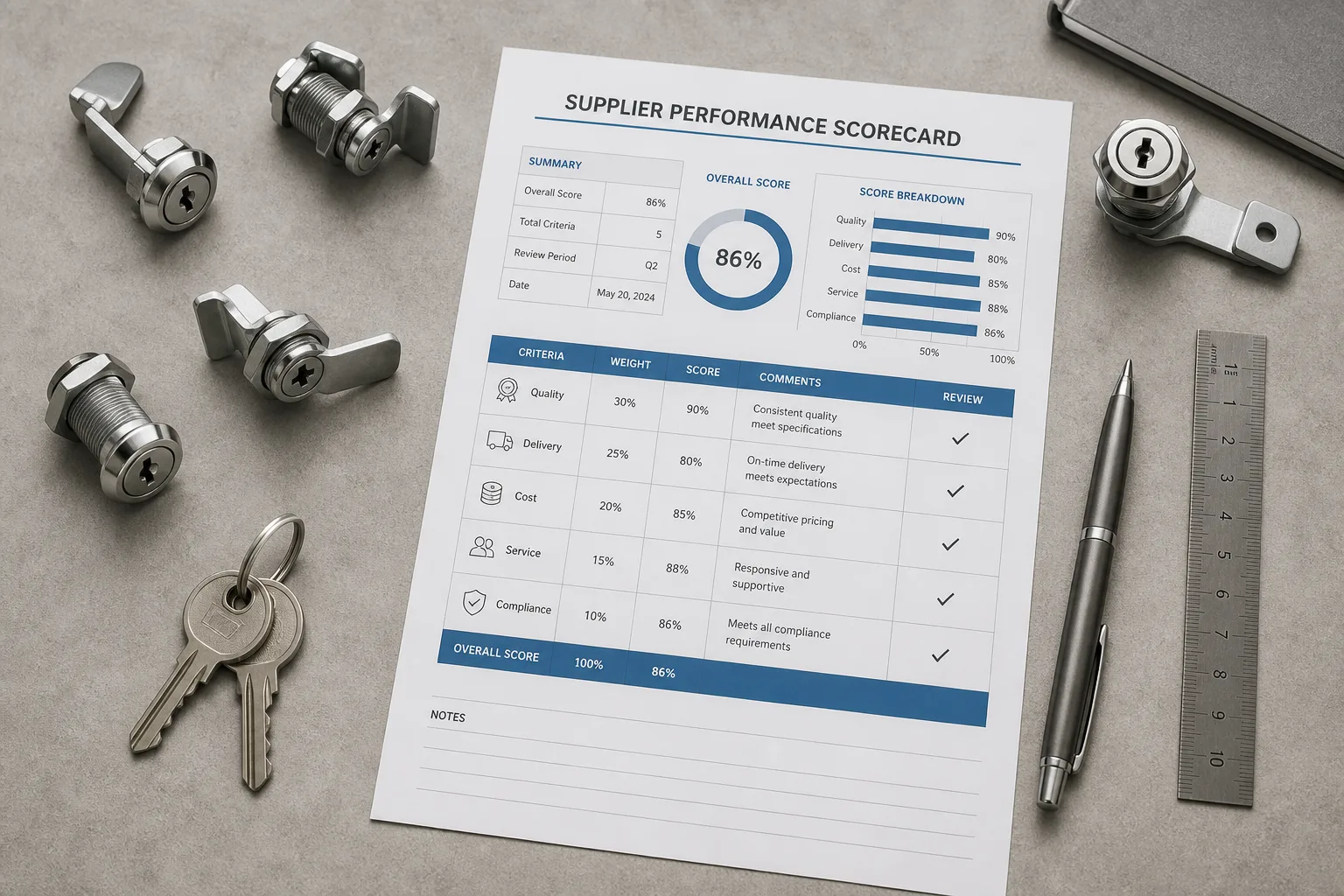
A lock supplier performance scorecard helps procurement and supplier-quality teams manage a supplier across real orders, even after the supplier passed an audit or delivered an acceptable sample. It provides a consistent way to compare what was promised with what actually happened, separate evidence from opinion, and decide which issue needs follow-through.
This lock supplier performance scorecard template helps B2B buyers review ongoing suppliers of cabinet, drawer, mailbox, locker, and enclosure locks. It organizes quality, delivery, documentation, change control, corrective-action responsiveness, and commercial execution into one review record. It is an original buyer-side editorial tool. It is not a universal industry standard, a WELLHW factory claim, or a substitute for a contract, inspection plan, or qualified technical decision.
Quick Answer
Build a lock supplier scorecard around a defined review period and the requirements that govern the orders in that period. Use objective records for quality, delivery, documentation, approved changes, corrective-action follow-through, and commercial execution. Define the formula and rating anchors before scoring, keep critical release or safety issues outside the weighted average, and convert every weak result into an owner, due date, and verification record.
What This Scorecard Owns
A performance scorecard is for ongoing supplier review after a supplier has been selected and orders have started. It should show trends and support a periodic business decision. It does not replace the records that establish whether a specific lot, shipment, or deviation may proceed.
| Tool | Primary job | Decision it should not replace |
|---|---|---|
| Supplier qualification or factory assessment | Decide whether a supplier is suitable to enter the approved sourcing process | Ongoing performance review after real orders |
| Inspection and acceptance record | Record what was checked for a defined sample, lot, or shipment | Supplier-level trend and periodic rating |
| Deviation request | Approve, reject, or hold one bounded departure from an approved baseline | Permanent supplier-performance status |
| Corrective-action record | Control containment, cause, action, effectiveness, and closure for an issue | The supplier’s complete performance picture |
| Performance scorecard | Summarize evidence across an agreed review period and trigger management actions | Release of a particular shipment or acceptance of a technical risk |
The ASQ Certified Supplier Quality Professional Handbook sampler describes ongoing performance monitoring after supplier selection and shows that scorecards may combine quality, delivery, cost, responsiveness, risk, and other measures. It also notes that the measures can vary with the risk of the supplied material. CIPS supplier-performance guidance likewise advises buyers to gather objective performance information and to align monitored objectives and targets with the contract. These sources support the method, but neither makes one metric set or weighting universal.
Define the Review Before Choosing Metrics
A score is not comparable if its scope changes silently. Record the period, supplier entity, site where relevant, product or order family, purchase orders included, excluded events, data cutoff, currency, and responsible reviewers. If one supplier serves unrelated programs with different requirements, use separate scorecards or clearly segmented sections.
| Control field | What to define | Why it matters |
|---|---|---|
| Review period | Start date, end date, and data cutoff | Stops late evidence from being applied inconsistently |
| Included business | Supplier entity, site, product family, project, POs, and destinations | Makes the denominator and responsibility visible |
| Governing baseline | Contract, purchase order, specification, approved sample, quality agreement, and packing instruction references | Ties ratings to approved requirements rather than memory |
| Data owners | Procurement, quality, engineering, logistics, finance, and supplier contacts as applicable | Shows who owns each source and challenge |
| Review purpose | Routine review, improvement plan, sourcing decision, escalation, or recovery follow-up | Prevents one score from being used for an unintended decision |
Choose Metrics That Can Be Reproduced
Start with a small set that can be calculated from controlled records. CIPS lists examples including product quality, incoming rejects, delivery accuracy, warranty claims, lead times, service, pricing compliance, and contract compliance. The ASQ sampler includes delivered quality, on-time delivery, corrective-action timing, cost, responsiveness, risk, and customer complaints among possible measures. Use only the measures that apply to the buyer’s program and that both parties can define.
| Category | Possible evidence-based measures | Source records | Definition questions |
|---|---|---|---|
| Quality execution | Accepted versus rejected receipts; nonconformance events; repeat issue status; approved rework or sort burden | Incoming, in-process, final, return, and nonconformance records | Is the unit a piece, line, lot, or receipt? How are approved deviations treated? |
| Delivery execution | On-time complete receipts; late or early receipts; quantity accuracy; agreed recovery performance | PO acknowledgments, approved date changes, shipment records, and receiving records | Which date and time zone govern? Does “on time” mean ship date or receipt date? |
| Documentation and change control | Required documents complete at release; correct revisions; changes notified and approved before implementation | Document register, release package, change notices, and approval records | Which documents were contractually required for each order? |
| Corrective-action responsiveness | Response submitted by the agreed date; overdue actions; effectiveness checks completed; repeat issue escalation | Corrective-action and issue logs | Does response time measure acknowledgment, containment, plan, implementation, or closure? |
| Commercial and order accuracy | Quotation or PO conformance; invoice accuracy; agreed packaging, labeling, and quantity execution | Quotation, PO, invoice, packing list, and receiving reconciliation | Were approved changes and buyer-caused changes removed from the exception count? |
| Working relationship | Meeting commitments, decision visibility, escalation discipline, and completion of agreed actions | Action register and dated meeting decisions | Can the rating be supported by named commitments instead of general impressions? |
Write the Formula Before You See the Result
Do not change weights, thresholds, exclusions, or rating anchors after seeing a supplier’s score. The following 100-point model is an editable example, not a recommended universal weighting:
| Example category | Example weight | Rating basis |
|---|---|---|
| Quality execution | 30 | Defined quality measures and evidence for the period |
| Delivery execution | 25 | Defined on-time and quantity-complete rule |
| Documentation and change control | 15 | Required release records and approved-change discipline |
| Corrective-action responsiveness | 15 | Agreed response, action, and verification milestones |
| Commercial and order accuracy | 10 | PO, invoice, packaging, label, and quantity conformance |
| Working relationship | 5 | Traceable commitments and escalation behavior |
| Total | 100 | Confirm before the review starts |
For a 0 to 5 rating scale, calculate each category’s weighted points as (rating ÷ 5) × category weight. Add the category points for a total out of 100. If a category has no applicable data, do not quietly award full points or enter zero. Mark it “not applicable” or “insufficient data,” record the reason, and apply the buyer’s pre-approved normalization rule.
Use Rating Anchors, Not Adjectives
| Rating | General anchor | Evidence requirement |
|---|---|---|
| 5 | Target met and no unresolved exception under the defined rule | Source records complete and reconciled |
| 4 | Target substantially met; limited exception handled within the agreed process | Exception and disposition recorded |
| 3 | Mixed result or minimum agreed threshold met with follow-up needed | Gap, owner, and due date recorded |
| 2 | Requirement or target missed in a material way | Issue record and recovery action required |
| 1 | Repeated or serious miss with inadequate recovery | Escalation and management decision required |
| 0 | Required performance failed and no acceptable evidence or response is available | Explicit hold, escalation, or sourcing decision recorded |
Replace these general anchors with category-specific rules. For example, delivery must define the promised date, allowed window, approved date-change treatment, and whether partial delivery counts. Quality must define the inspection unit and how an approved deviation, buyer-caused damage, or duplicate record is handled. Without those definitions, two reviewers can produce different scores from the same orders.
Keep Critical Gates Outside the Average
A weighted total can hide a serious open issue. A supplier could score well on delivery and commercial execution while one unresolved technical, safety, compliance, security-sensitive, or customer-mandated condition still blocks release. Add a separate gate section that cannot be offset by points.
Possible gate states are clear, open: release restricted, open: management decision required, and not applicable. The governing contract and authorized project owners must define which conditions trigger them. The scorecard records the state; it does not approve the risk.
Copy-and-Use Scorecard Template
Use one row per category or metric and keep the source reference beside the rating. Adapt the fields to the buyer’s contract and data systems.
| Section | Fields to capture |
|---|---|
| Control | Scorecard ID, version, status, review period, data cutoff, prepared by, reviewed by, and review date |
| Supplier and scope | Supplier entity, site, product family, project, included POs, excluded business, currency, and destinations |
| Baseline | Contract, quality agreement, PO terms, specifications, approved samples, packing instructions, targets, and revisions |
| Metric definition | Category, metric name, numerator, denominator, date rule, inclusion and exclusion rules, data owner, target, and weight |
| Period result | Actual result, rating, weighted points, evidence reference, prior-period result, and trend note |
| Critical gates | Gate type, state, linked issue, authority, restriction, required decision, and due date |
| Actions | Gap, action, owner, due date, linked corrective action or change record, verification method, and closure status |
| Decision | Continue, monitor, improvement plan, new-business restriction, requalification review, alternate-source review, or another authorized state |
For a spreadsheet, start with this column order:
Scorecard ID | Period | Supplier Entity | Site | Product/Program Scope | Included POs | Metric Category | Metric Definition | Target | Weight | Actual | Rating 0 to 5 | Weighted Points | Evidence Reference | Prior Result | Trend | Gate State | Gap | Action Owner | Due Date | Linked Record | Verification | Status | Reviewer | Decision Date
A Seven-Step Review Workflow
- Freeze the scope. Define the period, included supplier business, baselines, and data cutoff.
- Confirm metric rules. Agree definitions, targets, weights, anchors, exclusions, and missing-data treatment before scoring.
- Reconcile evidence. Match quality, logistics, procurement, finance, and issue records; remove duplicates and document approved exceptions.
- Calculate reproducibly. Keep the actual value, rating, formula, and evidence reference visible.
- Review critical gates. Separate any non-offsettable release, technical, compliance, customer, or security-sensitive condition from the total.
- Agree actions. Convert each material gap into an owner, due date, linked record, and verification method.
- Close and trend. Record the authorized supplier-status decision and compare the next period using the same definitions or a documented revision.
Connect the Scorecard to Existing Records
Use WELLHW’s lock quality control checklist to plan inspection and release evidence. Use the repeat-order change-control checklist when an approved baseline may change. Use the lock order deviation request for one bounded exception, and the supplier corrective-action record when cause, recurrence control, and effectiveness need a formal loop.
A scorecard can point to those records, but it should not restate or overwrite their decisions. For a new sourcing decision rather than ongoing performance, use the lock factory assessment guide.
Common Scorecard Mistakes
- Scoring before defining the rules. Freeze targets, weights, and exclusions first.
- Mixing incompatible scopes. Do not combine unrelated sites, product families, or requirement sets without segmentation.
- Using impressions as evidence. Tie ratings to records and named commitments.
- Letting a high average cancel a critical issue. Use separate non-offsettable gates.
- Penalizing approved buyer changes as supplier misses. Reconcile change and deviation records before calculating.
- Publishing a score without actions. Every material gap needs an owner, due date, and verification method.
- Changing the model without revision control. Record the effective period and reason whenever definitions or weights change.
What to Send for a Supplier Review
For a standard-model or custom-project discussion, send the product family, order period, relevant PO and drawing references, approved sample or specification reference where available, inspection and delivery records, open issue IDs, approved changes, and the decision you need to make. WELLHW can review the non-sensitive project information available for a standard-product or project discussion. Use the contact page and keep key-cut, credential, and other sensitive access-control data in an authorized secure channel.
Frequently Asked Questions
How often should a lock supplier scorecard be reviewed?
Use a period that matches order frequency, risk, and the buyer’s management process. Monthly, quarterly, or project-phase reviews can all be reasonable when the period and cutoff are consistent.
Should price be included in the same score?
Only when the buyer defines what is being measured and prevents negotiated changes, currency effects, or scope changes from being misclassified. Some teams keep commercial review separate from operational performance.
Can a supplier challenge a rating?
Yes. The process should allow a time-bound evidence correction or clarification without permitting informal changes to the formula. Record the challenge, evidence, decision, and revision history.
Does a low score automatically disqualify a supplier?
No. The buyer should define authorized decision bands and critical gates in advance. A score informs the decision; the contract, risk, open issues, alternatives, and designated authority govern the outcome.
