
A lock order can pass dimensional and functional inspection and still create receiving problems if the packaging, labels, pack quantity, accessories, or carton identification are wrong. A lock packaging approval record gives procurement, quality, operations, and the supplier one controlled reference for approving the complete pack-out before shipment.
This buyer-side template is designed for B2B cabinet, drawer, mailbox, locker, and enclosure lock programs. It does not prescribe a universal carton material, transit test, or label format. Instead, it helps the project team define what applies, inspect an identified packaging sample, record discrepancies, and release only the approved scope.
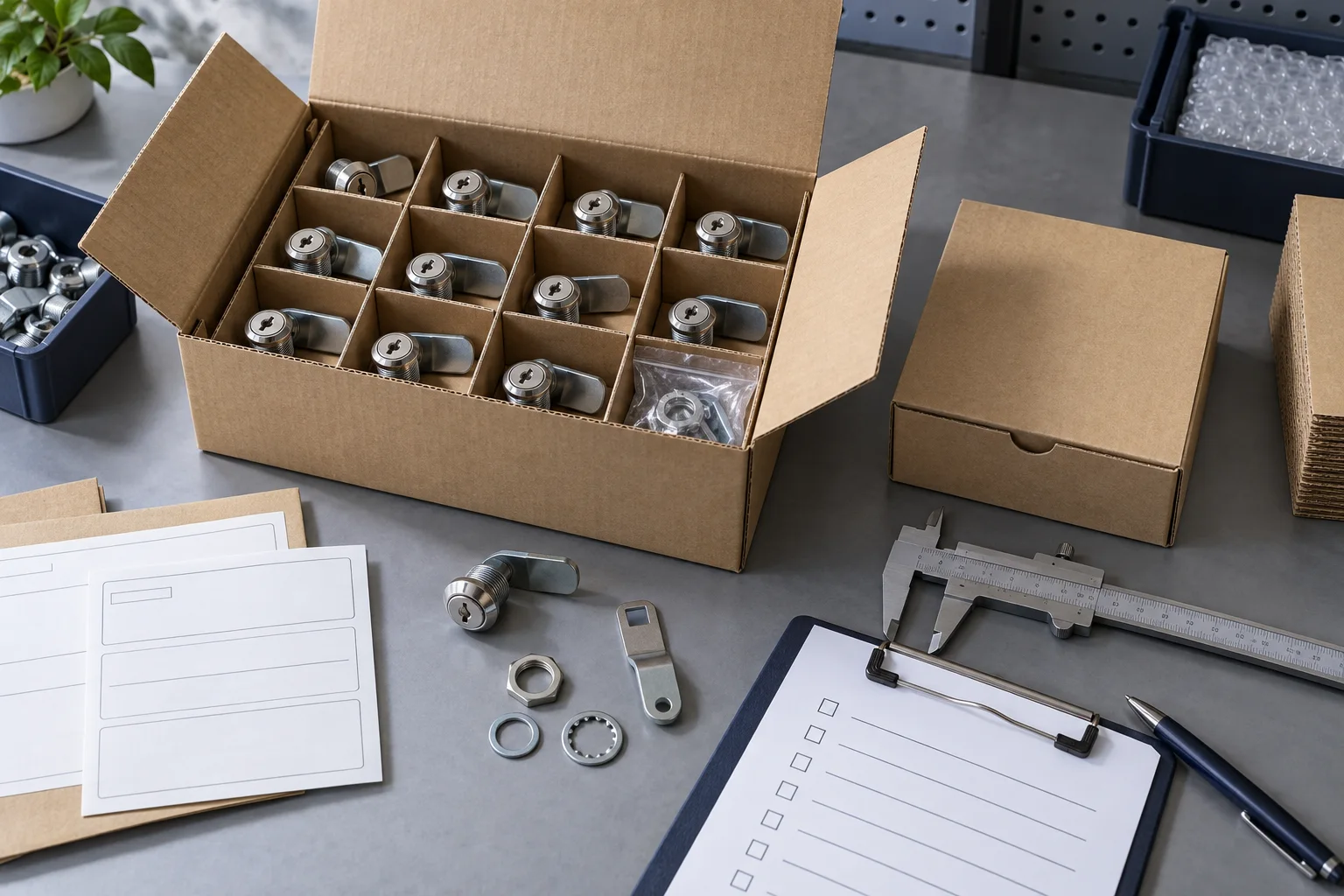
Quick Answer: What Should the Record Control?
The record should identify the order and SKU, the approved packaging revision, the exact sample reviewed, every packaging level, pack quantities, component and accessory segregation, label data, handling marks, applicable validation evidence, open issues, and the person authorized to release it. Approval should state a bounded result such as approved for this order and revision, not a vague “packaging looks good.”
Packaging Approval Is Not the Same as Product Inspection
A product inspection answers whether the lock and supplied components conform to controlled product requirements. Packaging approval answers whether the accepted product is packed, identified, and presented according to the commercial and logistics requirements for a defined order.
The two records should reference each other without being merged into one unchecked sign-off. Use the lock quality control checklist for product and lot evidence. Use this packaging record for the pack-out configuration that operations, the warehouse, a distributor, or an assembly line will actually receive.
When Should a Packaging Approval Record Be Opened?
Open a record before the first shipment of a new packaging configuration and whenever a change could alter identification, protection, quantity, handling, receiving, or customer presentation. Do not assume a previously accepted carton remains approved after an unrelated-looking change.
| Trigger | What to compare | Default action |
|---|---|---|
| New lock SKU or kit | Product, loose parts, keys, accessories, quantity, and identification | Approve the complete packaging hierarchy |
| New customer, channel, or destination | Customer label, language, handling, routing, and receiving requirements | Review affected levels and evidence |
| Artwork or label revision | File revision, data source, barcode or identifier, placement, and legibility | Approve a production-representative proof or sample |
| Pack quantity or assortment change | Unit, inner, master-carton, and pallet relationships | Recalculate and verify all counts |
| Material, divider, closure, or supplier change | Changed specification and any affected validation requirement | Route for documented reapproval |
| Damage, mix-up, or receiving complaint | Approved baseline versus shipped configuration and distribution conditions | Contain affected stock and open corrective action as needed |
The International Safe Transit Association says packaged-product retesting may be needed when the product, package, process, or distribution system changes. Its examples include changes to package configuration, dimensions, materials, closures, labels, manufacturing location, or distribution method. The project team should choose any test method and retest trigger based on its own distribution environment and contract, not from this article alone. See ISTA’s guidance on when a packaged-product should be retested.
Freeze the Approval Baseline Before Inspecting
A reviewer cannot approve packaging against a collection of screenshots and verbal comments. Assemble one controlled baseline and list every file by name, revision, and date. If an item is not yet released, mark it open rather than treating a draft as approved.
The baseline may include the purchase order, product or kit bill of materials, packaging specification, dieline or artwork, label data file, pack-count matrix, customer routing guide, approved product sample reference, and applicable validation plan. The supplier-document guide explains how to keep these records connected before bulk production.
Identify the Exact Packaging Sample
Record enough context to make the sample traceable: supplier, production or sample location, SKU, order number, sample quantity, sample date, packaging revision, product revision, and photographs. State whether the sample is handmade, digitally printed, pilot-produced, or taken from production, because different sample types may not represent every production condition.
If the review relies on a physical retained sample, assign an identifier and storage owner. If it relies on photographs or video, define which views are required. A useful photo set normally shows the product orientation, loose-part containment, inner pack, closed shipper, every label, and any pallet or unit-load arrangement relevant to the order.
Inspect Every Level of the Packaging Hierarchy
| Level | Questions to answer | Evidence to retain |
|---|---|---|
| Product protection | Are exposed finishes, threads, cams, clips, and accessories separated as required? Can loose items migrate into unwanted contact? | Open-pack photos and approved material/specification reference |
| Unit pack | Does one sellable or assembly unit contain the correct lock, keys, fasteners, instructions, and identifiers? | Contents photo and counted checklist |
| Inner pack | Is the quantity correct? Are variants or key groups segregated and identifiable without exposing restricted credential data? | Count result, separator layout, and label photo |
| Master carton | Do inner quantities reconcile to the carton total? Are closure, dimensions, weight data, and labels controlled? | Closed-carton views and measured or verified records |
| Pallet or unit load | When applicable, are carton arrangement, securing method, total quantity, and shipment identification defined? | Load diagram or photographs and count reconciliation |
Do not record confidential key cuts, credential hierarchies, or access assignments in a broadly shared packaging file. Reference a controlled identifier and keep sensitive data in an authorized project channel.
Control Quantity and Assortment with Reconciliation
“Ten pieces per carton” is incomplete when the shipped item is a kit. Define what one piece includes and make the arithmetic visible across unit, inner, master-carton, and pallet levels. Include spare parts or promotional inserts only when they are part of the approved order.
Example reconciliation fields
Units per unit pack: ____
Unit packs per inner: ____
Inners per master carton: ____
Calculated units per master carton: ____
Master cartons per pallet or unit load: ____
Calculated units per pallet or unit load: ____
Actual counted result: ____
Result: conforming / discrepancy opened
For mixed-SKU or mixed-key-group cartons, add an assortment table rather than relying on a single total. The total may be correct while the composition is wrong.
Verify Labels Against an Authoritative Data Source
Check labels field by field against the approved data source. Typical fields may include buyer SKU, supplier item reference, description, quantity, order number, batch or lot reference, country-of-origin wording when required, destination, and a machine-readable identifier. Which fields apply depends on the customer, destination market, logistics provider, and contract.
Record both the human-readable text and the scan or verification result when machine-readable data is used. A visually clean label is not sufficient if it encodes the wrong value. Also record the label revision, size, material or print method when controlled, placement, and whether old labels must be removed from reused containers.
Use Handling Symbols Only When They Apply
ISO 780:2015 covers graphical symbols used to communicate handling and storage instructions on distribution packages. It does not make protective packaging unnecessary, and it does not cover handling instructions specific to dangerous goods. Buyers should confirm which symbols and other legal or carrier markings apply to their shipment. See the official ISO 780:2015 record.
In the approval record, identify the source requirement for each handling mark, the approved symbol or artwork revision, its position, and the packaging level where it appears. Do not add symbols simply because they are common on other shipments.
Separate Visual Approval from Performance Evidence
A photograph can confirm layout, content, and label placement. It cannot by itself demonstrate performance through the intended distribution environment. If the contract requires transit, compression, vibration, drop, environmental, or other testing, list the applicable method, acceptance criteria, sample identity, report reference, and approving authority.
ISTA organizes packaged-product procedures into screening, partial-simulation, general-simulation, enhanced-simulation, member-performance, and development categories. Selecting a procedure requires knowledge of the packaged product and distribution system; this template does not select one for the buyer. See ISTA’s official test-procedure overview.
Record Discrepancies Without Approving Around Them
For each discrepancy, record the affected level, requirement, observed condition, evidence, quantity or scope, owner, due date, and disposition. Use a controlled deviation request when an authorized exception is being considered. Use the supplier corrective action record when the problem requires containment, cause analysis, corrective action, and effectiveness review.
Do not replace either process with comments such as “acceptable this time.” If the approval depends on a temporary exception, the packaging record should reference its identifier and expiration boundary.
Use Clear Packaging Release Statuses
| Status | Meaning | Allowed action |
|---|---|---|
| Not reviewed | No complete, identified pack-out has been assessed | Do not release packaging production or shipment |
| Review in progress | Evidence is incomplete or discrepancies remain open | Continue review; no implied approval |
| Approved for packaging production | The identified packaging configuration may be produced for the stated order and revision | Produce within the recorded boundary |
| Approved for shipment | Required packaging and shipment evidence is complete for the defined scope | Ship only the approved order, quantity, and revision |
| Rejected or superseded | The configuration may not be used, or a newer approval controls | Segregate obsolete material and follow documented disposition |
Copyable Lock Packaging Approval Record
1. Order and ownership
Buyer / project: ____
Supplier / site: ____
PO / order: ____
Buyer SKU / supplier item: ____
Product revision: ____
Packaging owner and approver: ____
2. Controlled baseline
Packaging specification and revision: ____
Artwork / dieline and revision: ____
Label data source and revision: ____
Pack-count matrix: ____
Customer / carrier / destination requirement: ____
Validation plan or report reference, if applicable: ____
3. Sample identity
Sample ID and date: ____
Sample type: handmade / proof / pilot / production
Quantity reviewed: ____
Photo or retained-sample reference: ____
4. Inspection results
Product protection: conforming / discrepancy ____
Unit pack and contents: conforming / discrepancy ____
Inner pack and count: conforming / discrepancy ____
Master carton and count: conforming / discrepancy ____
Labels and scanning: conforming / discrepancy ____
Handling marks: conforming / not applicable / discrepancy ____
Pallet or unit load: conforming / not applicable / discrepancy ____
Required performance evidence: complete / not applicable / open ____
5. Open-item routing
Discrepancy / deviation / corrective-action ID: ____
Affected quantity and location: ____
Containment or disposition: ____
Owner and due date: ____
6. Decision
Status: ____
Approved order / quantity / revision boundary: ____
Conditions or exclusions: ____
Approver, role, date, and signature method: ____
Reapproval triggers: ____
Hand the Approved Baseline to Production and Receiving
After approval, issue one controlled package containing the record, approved files, sample reference, photographs, and any required validation evidence. Production should know which revision to use and what changes require written reapproval. Receiving should know what to compare without needing the supplier’s informal explanation.
When a repeat order starts, compare the new packaging baseline with the last approved version using the repeat-order change-control checklist. A new file date, packaging supplier, closure, label, quantity, or routing requirement should not enter production unnoticed.
What to Send for a Supplier Packaging Review
Send the buyer SKU list, order quantity, product or kit contents, packaging hierarchy, count matrix, approved artwork and label data, destination and logistics assumptions, applicable customer or carrier requirements, sample expectations, validation requirements, and named approval authority. For private-label projects, connect this record to the broader private-label lock manufacturing preparation package.
For a project review, send WELLHW the lock or kit reference, quantities by SKU, required packaging levels, label files, destination, and any controlled customer or transit requirements through the contact page. The review can then identify missing inputs and determine whether an existing pack-out or a project-specific packaging proposal should be evaluated.
