
An approved lock sample can support future purchasing and quality decisions only when the team can prove which sample it is, what approval it represents, where it is stored, and whether it is still current. An approved lock sample retention record gives procurement, engineering, quality, and the supplier one controlled index for that work.
This buyer-side template is for cabinet, drawer, mailbox, locker, furniture, and enclosure lock programs. It helps a team manage physical reference samples and agreed photographic references after approval. It does not set a universal retention period, replace a drawing or specification, or release a product for production. Those decisions must come from the buyer’s approved requirements and named authorities.
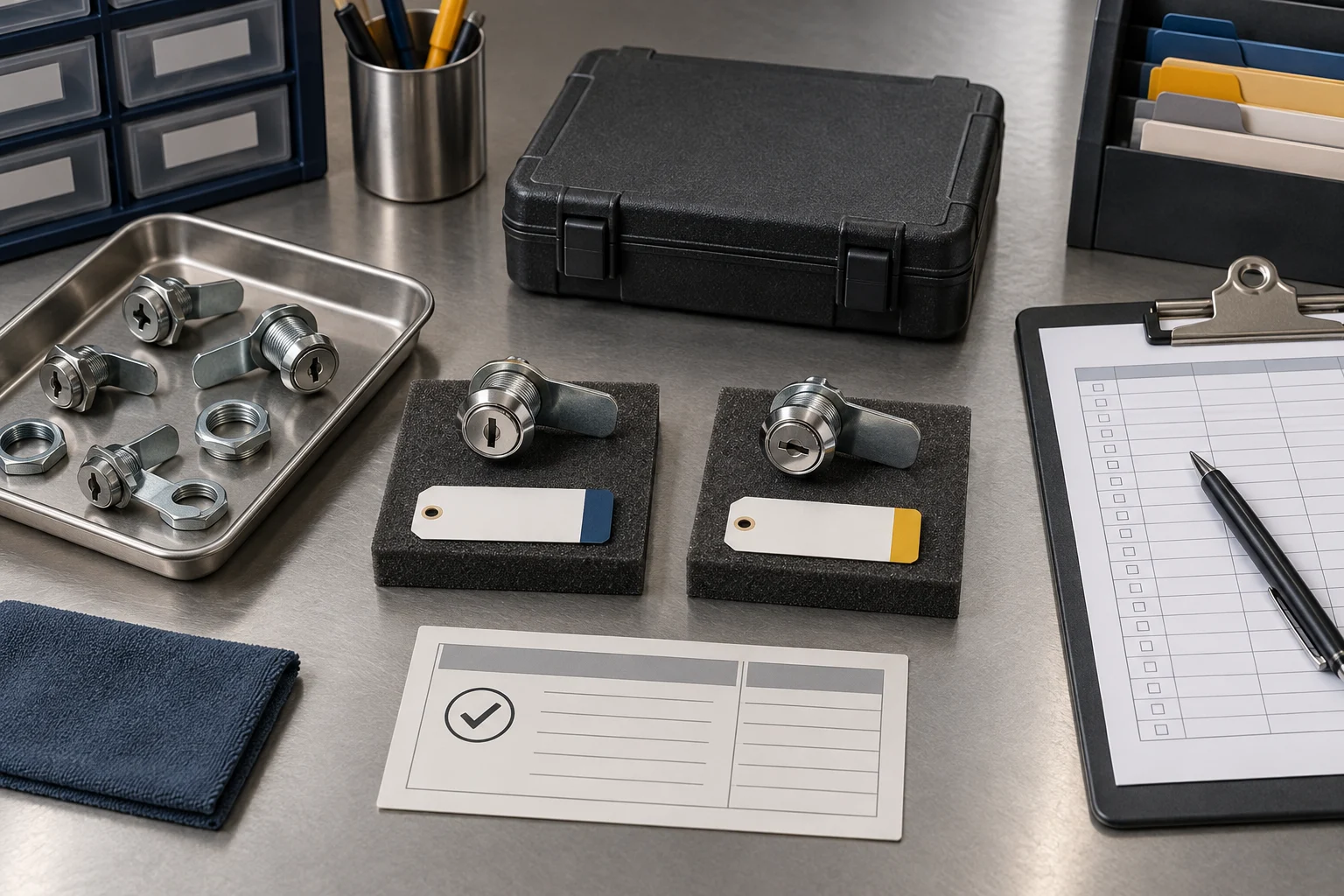
Quick Answer: What Should the Record Control?
The record should connect each retained sample to a stable sample ID, buyer and supplier part references, the approved drawing or specification revision, the approval decision and date, recorded exceptions, photographs, physical custodian, storage location, condition checks, access history, comparison use, replacement approval, and final disposition. The record should also state what the sample may be used to judge and what remains controlled by written requirements.
Keep Four Different Controls Separate
Teams often use “golden sample” as if one object controls every decision. That creates ambiguity. A physical sample can help compare appearance, assembly, or other agreed attributes, but it should not silently replace controlled documents or an inspection plan.
| Control item | Primary purpose | What it should not do alone |
|---|---|---|
| Drawing or specification | Defines the approved written product and acceptance requirements | Prove that one physical item was made and accepted under that revision |
| Approval record | Records the reviewed item, evidence, decision, exceptions, scope, and approver | Preserve a physical or visual reference indefinitely |
| Retained physical sample | Provides an identified comparison reference for the attributes explicitly assigned to it | Override a drawing, authorize a change, or establish an unrecorded tolerance |
| Photographic reference | Preserves visible identity and condition when photography is suitable for the agreed purpose | Reliably establish scale, feel, operation, hidden construction, or color without controlled capture conditions |
Write the hierarchy into the record. If a written requirement conflicts with a sample, the team needs a defined escalation path; it should not choose whichever reference is more convenient.
Decide When a Retained Sample Adds Value
Retain a sample only when it has a named future use. Examples include comparison during repeat-order review, confirming an agreed visual boundary, supporting supplier or incoming-inspection training, investigating a later mismatch, or linking a released product state to a specific approval record. The responsible team should decide whether a physical item, controlled photographs, another evidence type, or a combination is appropriate.
Do not retain an item merely because it was the first one received. The sample should come from a defined source and approval event. SKF’s Alemite Supplier Quality Manual, for example, lists a master PPAP sample as a supplier-retained item in its submission table. Downer’s Supplier Quality Manual describes retention and identification expectations for production master samples or agreed photographic representations. These are customer-specific examples, not universal rules for lock orders. Use the requirements agreed for the actual project.
Open the Record at the Approval Decision
Create the retention entry while the reviewed evidence is available. If the sample was part of a new or changed production setup, link it to the first article inspection record. The first article record owns the comparison with controlled requirements and the release decision. The retention record begins after that decision and controls the reference through storage, use, replacement, and closure.
Record any limitations exactly. “Appearance reference only,” “packaging not included,” or “approved with the exceptions listed in record AR-___” is more useful than an unexplained APPROVED label. Never add a later use to the sample’s scope without a new authorized decision.
Give Every Sample a Stable Identity
| Identity field | What to enter | Why it matters |
|---|---|---|
| Sample ID | A unique internal reference that remains stable | Prevents a photo, box, and approval email from becoming separate unidentified records |
| Product references | Buyer SKU, supplier reference, product family, and application | Distinguishes similar-looking locks and variants |
| Controlled baseline | Drawing, specification, artwork, packaging, or other applicable revision | Shows which approved state the sample represents |
| Source | Order, lot, trial, sample request, or other traceable origin | Connects the object to the event that produced it |
| Approval reference | Approval record ID, decision, date, scope, exceptions, and approver | Stops the object from acquiring broader authority than it was given |
| Visual record | Overall image, label or tag image, relevant views, image date, and file location | Supports remote reconciliation and condition checks |
Use non-sensitive identifiers on broadly shared records. Do not expose key codes, key-bitting details, access credentials, proprietary drawings, or facility-security information merely to make the entry look complete.
Define the Sample’s Permitted Comparison Scope
A useful record says which decisions the sample supports. The scope might cover an agreed visible finish, marking position, assembled appearance, component arrangement, packaging presentation, or another buyer-defined attribute. It may exclude dimensions, internal construction, material verification, performance, key-system logic, or any attribute governed elsewhere.
Comparison-scope statement
This sample may be used to compare: ____
The controlling written references are: ____
This sample does not determine: ____
Recorded approval exceptions: ____
Conflicts must be escalated to: ____
For appearance decisions, document viewing or capture conditions when they matter to the buyer. A photograph viewed on different screens may not reproduce color consistently. If a visual boundary is commercially important, the responsible team should define how the comparison will be made rather than treating an ordinary phone photo as a universal standard.
Assign Custody, Location, and Access
State who physically holds each sample, the storage location, the named custodian or role, and the last date verified. If buyer and supplier each retain a counterpart, give them separate IDs or copy numbers and cross-reference them. Do not assume two samples are interchangeable simply because both were approved on the same day.
Use a movement log when a sample leaves storage. Record the borrower, purpose, destination, issue date, expected return, condition at issue, return date, condition at return, and any incident. This is especially useful when samples travel to another office, supplier, inspection site, or production line for comparison.
Protect the Sample Without Inventing a Storage Standard
The storage method should preserve the attributes for which the sample is retained. The responsible team should define packaging, handling, environment, security, and separation based on the actual material, finish, components, expected retention period, and intended comparison. This template does not prescribe a temperature, humidity, inspection frequency, or universal shelf life.
At each planned or event-driven check, record identity confirmation, packaging condition, visible condition, missing or loose components, corrosion or contamination observations where relevant, tag legibility, location, and whether the sample remains suitable for its stated use. If suitability is uncertain, change the status to hold and obtain an authorized decision.
Use Clear Lifecycle Statuses
| Status | Meaning | Next action |
|---|---|---|
| Candidate | Identified for review but not approved as a retained reference | Complete the applicable approval process |
| Current reference | Approved for the recorded scope and baseline | Store and use only within that scope |
| Checked out | Temporarily issued for a recorded comparison or review | Track custody and condition until return |
| Hold | Identity, condition, location, or authority is uncertain | Stop using it as a reference and resolve the open item |
| Superseded | A newer reference has been approved for some or all of its former scope | Mark the effective boundary and prevent accidental current use |
| Archived | Kept for history or investigation but not for current acceptance | Separate it visibly from current samples |
| Disposed or returned | The physical sample is no longer retained by that custodian | Record authority, date, method, and receiving or disposal evidence |
Replace a Reference Through a Controlled Decision
Damage, loss, fading, corrosion, a revised product, a supplier change, or a new approved baseline may make a sample unsuitable. Do not quietly swap the object and keep the old ID. Open a replacement record that identifies the reason, proposed new sample, governing revisions, comparison evidence, approval authority, and effective boundary.
If the product or order baseline is changing, use the repeat lock order change-control checklist. A retention record can show which sample became current, but it should not approve the underlying product change. If the replacement is needed because of a nonconformity, link the decision to the relevant supplier corrective action record without treating sample replacement as proof that the issue is closed.
Copyable Approved Lock Sample Retention Record
1. Sample and project identity
Sample ID / copy number: ____
Buyer SKU / supplier reference: ____
Product family and application: ____
Sample source, order, lot, or trial: ____
Quantity and included components: ____
2. Governing approval
Approval record ID and date: ____
Drawing / specification / artwork revisions: ____
Decision and approver: ____
Approved comparison scope: ____
Excluded attributes: ____
Exceptions and open actions: ____
3. Identification evidence
Tag or label reference: ____
Photograph file references and date: ____
Distinguishing features that do not expose sensitive data: ____
Cross-reference to counterpart sample: ____
4. Custody and storage
Owning organization or record owner: ____
Physical custodian and location: ____
Storage and handling instruction reference: ____
Access authorization: ____
Planned review trigger: ____
5. Condition and movement history
Last verification date / verifier: ____
Identity and condition result: suitable / restricted / hold
Check-out purpose, holder, issue date, and due date: ____
Return date and condition: ____
Incident or corrective-action reference: ____
6. Replacement and closure
Current / superseded / archived / disposed / returned: ____
Replacement sample ID: ____
Effective order, lot, date, or other boundary: ____
Disposition authority and date: ____
Return or disposal evidence: ____
Common Failures to Prevent
- An “approved” sticker with no approval record: the object has no defensible scope or revision.
- One sample used for every attribute: a visual reference starts overriding written requirements or inspection evidence.
- Buyer and supplier copies share one identity: damage or replacement of one copy cannot be traced.
- Location is overwritten: the team loses the custody trail.
- Ordinary photos treated as a complete substitute: scale, color, hidden features, or operation are inferred without an agreed method.
- A damaged sample remains current: comparison continues after suitability is uncertain.
- A new sample silently replaces an old one: the effective boundary and approval basis disappear.
- Obsolete samples remain beside current ones: production or inspection can select the wrong reference.
How This Record Fits the Wider Lock-Control System
Use the approval or first article record to decide whether the identified item meets the applicable requirements. Use this retention record to control the accepted reference afterward. Use the change-control record when a repeat order differs from the approved baseline. Use the lock packaging approval record when the retained reference is specifically for packaging configuration, labels, artwork, or pack hierarchy.
Keeping these records separate makes ownership clear: approval establishes the decision, retention preserves the reference, change control governs a proposed difference, and corrective action addresses a detected quality issue.
What to Send for a Sample-Control Review
Send the buyer and supplier product references, application, governing drawing or specification revisions, sample source, approval record, intended comparison scope, exceptions, photographs, proposed custodian and location, storage considerations, review triggers, replacement authority, and the people responsible for engineering, quality, and commercial decisions.
For a project review, send WELLHW the non-confidential lock reference, application, order stage, approval evidence, and the questions your team needs resolved through the contact page. Keep sensitive key data and proprietary documents in an authorized project channel rather than a broadly shared sample register.
