
A shipment label can identify a carton without proving which components, production records, inspections, and approved revisions belong to the locks inside it. A lock lot traceability record closes that gap by linking each defined output lot to its source records and to the orders, packages, and shipments that received it.
This buyer-side template is for procurement, supplier-quality, operations, engineering, and after-sales teams managing cabinet, drawer, mailbox, locker, furniture, or enclosure lock orders. It does not prescribe a universal lot size, marking method, retention period, inspection plan, or compliance outcome. Those requirements must come from the buyer’s contract, risk assessment, quality agreement, and applicable authority.
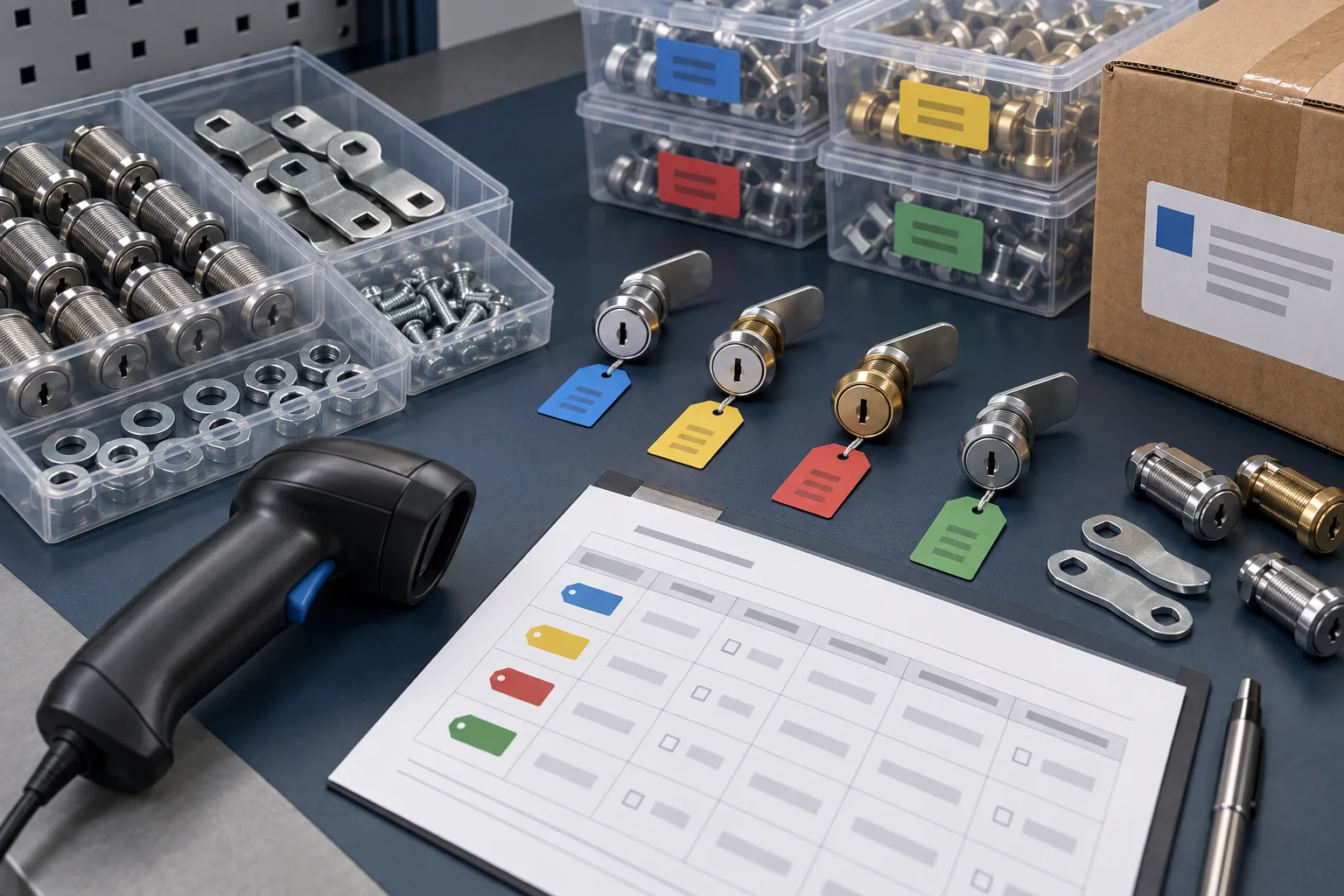
Quick Answer: What Should a Lock Lot Traceability Record Do?
The record should answer two bounded questions. Starting with a finished lock lot or shipment, can the team trace backward to the applicable product revision, input lots, production order, inspection evidence, approved exceptions, packaging configuration, and release record? Starting with a suspect input, process event, or inspection result, can the team trace forward to the finished lots, inventory locations, packages, shipments, and customers within the authorized investigation?
A useful record does not claim more precision than the underlying identifiers support. If two input lots were mixed, a lot was split, or traceability was lost at a handoff, the record should show that boundary as an exception instead of inventing a narrower scope.
Separate Identity, Genealogy, Conformance, and Release
Traceability shows relationships between records and physical product. It does not prove that the product conforms. Keep these four controls distinct so a lot code does not become an unsupported quality claim.
| Control | Question it answers | What it does not prove alone |
|---|---|---|
| Product identity | Which part, configuration, revision, quantity, and physical units are being discussed? | Which sources and process records produced them |
| Lot genealogy | Which defined inputs, operations, outputs, and movements are linked? | That every requirement was met |
| Inspection or test evidence | What was checked, by which approved method, against which acceptance source, and with what result? | Where every affected unit was shipped |
| Release or disposition | Who authorized use, shipment, hold, rework, return, or another action, and for what scope? | That the underlying genealogy is complete |
The first article inspection record owns the initial comparison with released requirements. The traceability record carries the applicable identity and evidence links through later production and shipment. If a result fails, route the issue to the relevant inspection, deviation, or corrective-action process instead of changing the traceability record into an approval.
Define the Traceability Boundary Before Choosing Fields
Start with the buyer decision the system must support. A basic commercial order may need order-to-shipment traceability. Another project may require links to specified component lots, an outsourced finish batch, packaging labels, or individual serialized units. Do not copy a regulated-industry model into an ordinary lock order without a documented reason, and do not assume that a carton label provides component-level genealogy.
Record the boundary in plain language:
Traceability boundary statement
Starting object: ____
Backward trace must reach: ____
Forward trace must reach: ____
Included components, processes, and records: ____
Explicit exclusions: ____
Required identification level: lot / package / unit / other ____
Governing customer, contract, quality, or regulatory reference: ____
Two current supplier manuals illustrate why project rules matter. The Littelfuse Supplier Quality Manual, Revision E2 describes identification through receipt, work in process, storage, and delivery, with links to raw-material, manufacturing, inspection, and test records. Lockheed Martin UK’s QM003, Issue 11 sets its own contract-specific traceability expectations and links product identity to configuration and certification records. These are examples of customer requirements, not universal rules for WELLHW orders. Apply only the requirements governing the actual project.
Build One Identifier Chain
The record should connect identifiers already used by purchasing, production, quality, warehousing, and logistics. A separate spreadsheet that renames every object may create another reconciliation problem. Define which system or document owns each identifier and how corrections are controlled.
| Stage | Possible identifiers | Evidence link | Control question |
|---|---|---|---|
| Buyer requirement | Buyer part number, purchase order, line item, drawing or specification revision | Released requirement set | Which approved product state was ordered? |
| Supplier order | Supplier part reference, sales order, production order, traveler, or work order | Order review and production record | Which internal order represents the buyer line item? |
| Inputs | Applicable component, material, subassembly, finish, or outsourced-process lot references | Receiving, certificate, or supplier record as required | Which controlled inputs entered the defined output lot? |
| Production output | Finished lot, batch, unit, date code, or another approved identifier | Assembly, process, and quantity record | Which physical quantity shares this identifier? |
| Quality evidence | Inspection report, test report, deviation, hold, or release reference | Controlled result and decision | Which evidence applies to this output? |
| Packaging | Pack record, carton ID, pallet ID, label revision, quantity | Approved packaging and reconciliation record | How was the lot divided or combined for shipment? |
| Distribution | Shipment, delivery, invoice, receiving, or customer-order reference | Dispatch and receipt evidence | Where did each defined quantity go? |
Use references rather than copying confidential drawings, full inspection files, or sensitive access data into a broadly shared register. Key codes, bitting details, credential lists, master-key relationships, proprietary drawings, and facility-security information belong in authorized project systems with appropriate access control.
Record Splits, Merges, Rework, and Other Transformations
A simple one-lot-in, one-lot-out chain is easy to read. Real orders may split one production lot across several cartons or shipments, combine approved component lots into one assembly lot, move part of a lot to hold, or return material for controlled rework. The record must preserve those transformations.
| Event | Minimum relationship to retain | Failure to prevent |
|---|---|---|
| Split | Parent lot, child container or sublot IDs, quantity allocated to each, date, and owner | One suspect lot appears smaller than the quantity actually distributed |
| Merge | Every contributing lot, receiving status, quantity used, resulting output lot, and authorization | A single output ID hides multiple sources |
| Rework | Original lot, affected quantity, rework order, applicable instruction, new or retained identity, inspection, and disposition | Reworked units return to stock with no visible history |
| Hold and partial release | Lot, reason, quantity on hold, quantity released, locations, decision records, and effective time | Released and restricted quantities become indistinguishable |
| Return | Shipment source, returned quantity and identity, condition, investigation reference, and disposition | Returned product is mixed back into usable stock without review |
| Relabel or repack | Old and new package IDs, lot identity, quantities, reason, label or packaging revision, and approval | The physical label no longer matches the genealogy record |
Never overwrite the original relationship simply because an item moved. Add a controlled event that shows the before and after state. If an identifier was entered incorrectly, retain the correction history, reason, author, and date according to the governing record-control procedure.
Link Quality Status Without Hiding Open Issues
Use a small set of explicit status values and keep the status owner separate from the person entering genealogy data. Adapt the labels to the buyer’s system.
| Status | Meaning | Allowed next step |
|---|---|---|
| Unverified | Relationships were entered but not checked against source records | Verify before relying on the chain for a release or scope decision |
| Verified | Required links were checked for the stated boundary | Use within the recorded scope |
| Hold | Identity, genealogy, quantity, or quality status is unresolved | Prevent unintended movement or use until disposition |
| Released | An authorized record permits the stated quantity and scope to proceed | Move or ship only within the release boundary |
| Partially released | Only a defined quantity or sublot is released | Separate released and restricted identities and locations |
| Superseded or closed | The record is historical or replaced by a controlled successor | Preserve the reference and direct users to the current record |
A traceability record may point to a pass, fail, approved deviation, or open corrective action. It should not rewrite those decisions. Use the lock order deviation request for a bounded exception and the supplier corrective action record for cause, action, effectiveness, and closure.
Verify the Chain With a Two-Way Trace Exercise
Do not wait for a complaint to discover that records cannot be joined. Select an identified finished lot, package, or shipment and trace backward to the boundary defined by the project. Then select one applicable input lot, process event, or quality record and trace forward to every known output, inventory location, and shipment within scope.
Record the exercise date, starting identifier, requested boundary, records reviewed, quantities reconciled, gaps, ambiguous links, unavailable evidence, people consulted, result, actions, owners, due dates, and closure evidence. The exercise should test the actual record path, not a demonstration folder prepared separately from normal operations.
Do not publish a universal completion time or pass percentage in a generic template. The buyer should define the required response, reconciliation, frequency, sample, and escalation rule based on contract, risk, system capability, and applicable obligations.
Copyable Lock Lot Traceability Record
1. Record scope
Record ID / revision / status: ____
Buyer organization and program: ____
Supplier and manufacturing source reference: ____
Traceability boundary and purpose: ____
Governing purchase, quality, customer, or regulatory references: ____
2. Product and order identity
Buyer part number / supplier part number: ____
Product description and application: ____
Drawing / specification / approved sample revisions: ____
Purchase order / line item / supplier order: ____
Ordered and produced quantities with units: ____
3. Finished lot or unit identity
Finished lot, batch, unit, or date-code reference: ____
Definition of what shares this identifier: ____
Production order / work order / applicable location: ____
Quantity created / accepted / held / rejected: ____
Physical marking or label reference: ____
4. Input genealogy
Component or material reference / supplier / input lot / quantity used: ____
Outsourced process or finish reference / lot or batch: ____
Receiving and release record references: ____
Substitutions, merges, shortages, or unlinked inputs: ____
5. Process and quality evidence
Applicable process record references: ____
Inspection and test report references: ____
First article / approved sample references: ____
Hold, nonconformity, deviation, rework, or corrective-action references: ____
Release or disposition authority, date, quantity, and scope: ____
6. Packaging and distribution
Packaging approval or pack record: ____
Carton / pallet / package IDs and quantities: ____
Split, merge, relabel, or repack events: ____
Shipment / invoice / delivery references: ____
Destination and receiving confirmation where applicable: ____
7. Reconciliation and verification
Backward trace starting ID and result: ____
Forward trace starting ID and result: ____
Quantity reconciliation: ____
Missing, ambiguous, or conflicting links: ____
Verified by / date / evidence reviewed: ____
8. Actions and closure
Immediate containment or access restriction: ____
Action / owner / due date: ____
Corrected record or system reference: ____
Closure evidence and approver: ____
Retention and disposal rule reference: ____
Common Traceability Failures to Prevent
- A lot code with no definition: no one knows which quantity, time window, configuration, or process state it represents.
- Input lists without where-used links: a suspect component can be traced backward but not forward into finished orders.
- Shipment records without package reconciliation: the team cannot map a production lot to the cartons or customers that received it.
- Mixed lots recorded as one source: the affected scope is stated more narrowly than the evidence supports.
- Rework erases history: a new status hides the original nonconformity, quantity, or instruction.
- Free-text identifiers: small naming differences prevent reliable joins across purchasing, quality, warehouse, and shipping records.
- Traceability treated as release: a complete chain is mistaken for evidence that the product passed inspection.
- Sensitive key data copied into the register: broad visibility creates an avoidable access-control risk.
- No two-way exercise: the system appears complete until an urgent investigation exposes broken links.
How This Record Fits the Wider Lock-Control System
Use the repeat lock order change-control checklist to decide whether a new order differs from the approved baseline. Use the first article record to evaluate an identified production result. Use the lock packaging approval record to approve the pack-out, labels, quantities, and release evidence. Use this traceability record to connect the resulting product and evidence across inputs, production, inventory, packaging, and shipment.
Keeping these tasks separate gives each record a clear owner. Change control governs proposed differences. Inspection records evidence conformance. Packaging approval governs the complete pack-out. Traceability preserves the relationships needed to define an affected scope later.
What to Send for a Traceability Review
Send the buyer and supplier part references, application, drawing or specification revisions, purchase-order line, proposed lot definition, required backward and forward boundaries, component and outsourced-process links, inspection and release references, packaging hierarchy, label fields, shipment references, expected exceptions, record-retention rule, and the people authorized to decide quality and commercial actions.
For a project review, send WELLHW the non-confidential product reference, application, order stage, required traceability boundary, and current record gaps through the contact page. Keep controlled drawings, key codes, credential details, and customer-sensitive distribution data in the agreed authorized channel.
