
A lock inspection result is only as useful as the evidence behind the measuring device that produced it. A lock inspection equipment calibration record helps procurement, supplier-quality, engineering, and operations teams connect each caliper, micrometer, gauge, fixture, or test device to its intended use, current status, supporting evidence, and the product decisions that relied on it.
This buyer-side template applies to cabinet, drawer, mailbox, locker, furniture, and enclosure lock programs. It does not prescribe a universal calibration interval, accuracy ratio, acceptance tolerance, laboratory, or certificate format. Those decisions must come from the measurement task, product requirement, risk, contract, applicable quality system, and authorized technical owners.
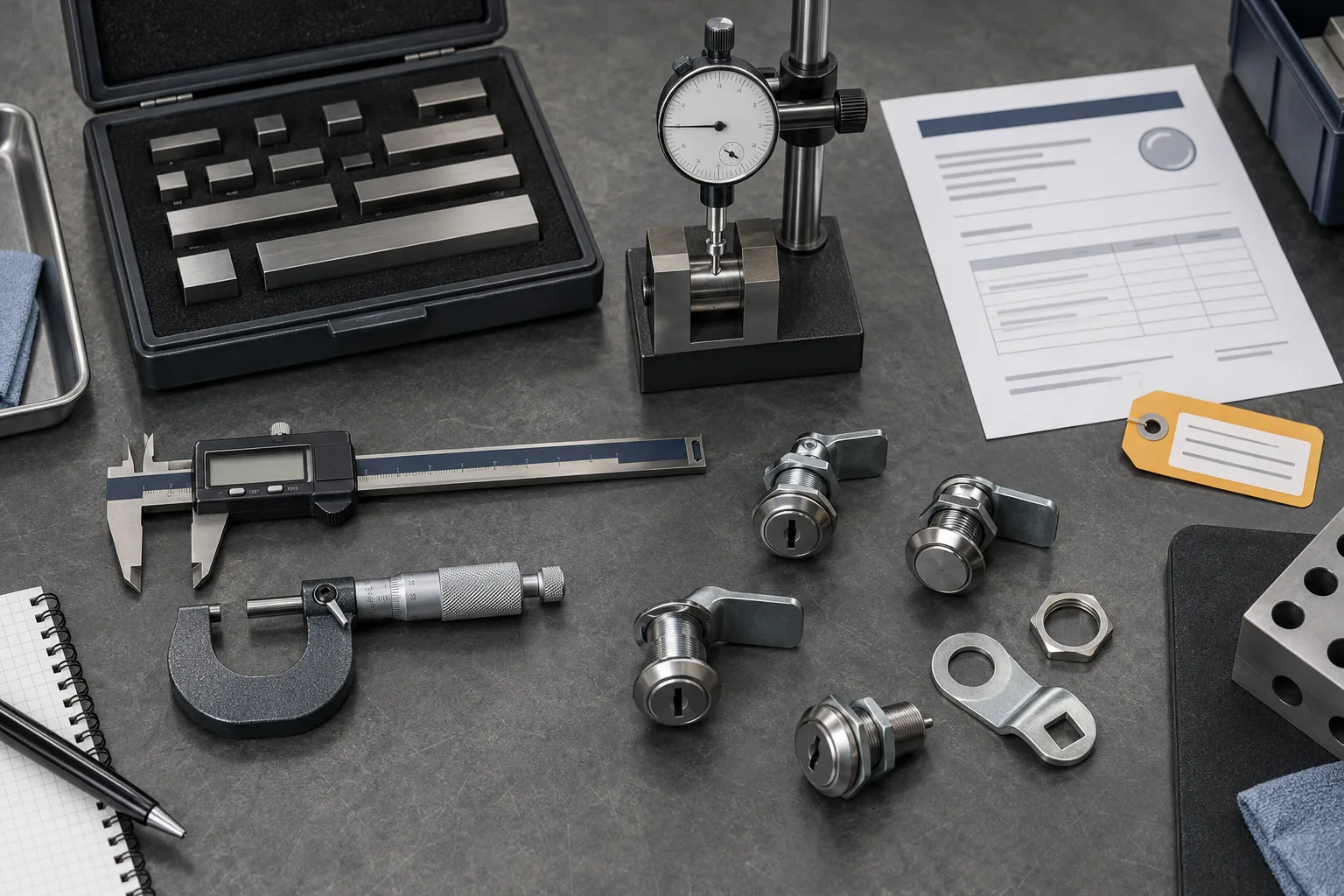
Quick Answer: What Should the Record Control?
The record should identify the device, owner, location, intended measurement task, required range and resolution, applicable procedure, status evidence, certificate or verification reference, valid-use boundary, next review trigger, and any product records affected when the device is unavailable or found outside its approved condition.
The record should not reduce status to a sticker date. A buyer needs enough evidence to answer four questions: Was this the correct device for the task? Was its status acceptable when the measurement was made? What evidence supports that status? Which inspection, release, or shipment decisions used its results?
Start With Intended Use, Not the Device Name
Two devices of the same type may need different controls because they support different decisions. A caliper used for a rough setup check is not automatically controlled in the same way as one used to accept a drawing characteristic. The ISO 9001 Auditing Practices Group guidance on monitoring and measuring resources states that the needed level of control depends on intended use and that the decision to calibrate or verify can vary with the process, output, product, service, and related risk.
For every device, record the specific task before selecting the control method:
| Use question | Record the answer | Why it matters |
|---|---|---|
| What characteristic is evaluated? | Feature, quantity, condition, or attribute, plus the governing drawing, specification, control plan, or inspection instruction | Prevents a generic device status from being applied to an unrelated task |
| What decision uses the result? | Setup, process monitoring, first article, incoming inspection, final inspection, release, or investigation | Shows the consequence of an unreliable result |
| What capability is required? | Required range, resolution, method, fixture, software, environment, and other project-defined conditions | Supports technical selection without inventing a universal rule |
| What evidence is required? | Calibration, verification, comparison, functional check, certificate, or another approved record | Aligns status evidence with the intended use |
| Who may decide suitability? | Named role or authority in the buyer’s or supplier’s quality system | Separates data entry from technical approval |
Keep Calibration, Verification, Adjustment, and Use Approval Separate
NIST explains that measuring systems may be characterized through calibration, adjustment, and verification or testing, and that these activities do not mean the same thing. NIST also notes that metrological traceability is a property of a measurement result, supported by a documented chain, rather than a label that belongs to an instrument by itself.
| Control | Question it answers | What it does not prove alone |
|---|---|---|
| Calibration | What relationship was established between indications and stated reference values under documented conditions? | That the device is suitable for every lock characteristic or that every later result is traceable |
| Verification | Did the item meet the specified requirement used for this check? | The full error information or measurement uncertainty that a calibration may report |
| Adjustment or repair | What changed to restore or alter device performance? | That post-adjustment status has been confirmed |
| Intermediate or pre-use check | Did an approved comparison or functional check show acceptable condition at the point of use? | A substitute for required calibration or formal verification |
| Use approval | Did an authorized person confirm that the evidence, range, method, and status fit the intended task? | That the product itself conforms |
Use the exact term shown in the governing procedure and source evidence. Do not call every status activity a calibration, and do not advertise a result as “NIST certified.” NIST states that using an item calibrated by NIST is not, by itself, enough to establish traceability for later measurement results. The organization making the traceability claim remains responsible for documenting the measurement system and chain that support the result.
Build One Equipment Identity and Evidence Chain
The equipment register should use a stable asset identifier that appears on the physical device, in the status evidence, and in the inspection record. If an external laboratory uses its own reference, keep both identifiers and show the relationship.
| Record group | Fields to retain | Control question |
|---|---|---|
| Identity | Asset ID, device type, manufacturer and model where approved, serial reference, owner, custodian, and physical location | Can the record be matched to one physical item? |
| Intended use | Characteristic or task, method, range, resolution, fixture, software, and environmental or handling conditions where applicable | What decision is the device allowed to support? |
| Status evidence | Activity type, provider, procedure, certificate or result reference, date, conditions, reported findings, limitations, and approval | What evidence supports current use? |
| Validity boundary | Approved range, stated exclusions, status start, next due date or review trigger, and required intermediate checks | Where does the evidence stop applying? |
| Use history | Inspection report, first article, lot, work order, product release, or other decision records that reference the asset ID | Which product decisions may need review if status changes? |
| Events | Damage, overload, abnormal result, failed check, repair, adjustment, relocation, software change, storage issue, loss, or overdue condition | What event could invalidate continued use? |
| Disposition | Available, restricted, quarantined, under review, repaired, retired, lost, or superseded, with owner and date | What may happen next? |
Keep sensitive drawings, customer tolerances, key codes, master-key relationships, and access-control data in authorized systems. The equipment record can point to controlled documents without copying confidential content into a broad register.
Review the Certificate or Verification Evidence, Not Just the Date
A due date alone cannot show whether the evidence covers the intended task. The buyer or authorized quality owner should review the evidence fields required by the project and procedure.
- Identity match: the certificate or result identifies the same device or a documented linked reference.
- Scope match: the activity covers the range, function, or parameter needed for the lock inspection task.
- Method and conditions: the record identifies the applicable procedure and relevant conditions or limitations.
- Result clarity: the evidence distinguishes recorded observations, adjustments, exceptions, and the final status.
- Reference chain: any traceability statement is supported by the documented references required for that claim.
- Decision authority: an authorized role decides whether the evidence is acceptable for the intended use.
- Retention and retrieval: the record can be retrieved for the product decisions and period governed by the project.
NIST’s metrological traceability guidance emphasizes a documented unbroken chain of calibrations, stated measurement results and uncertainties, descriptions of the measurement system, reference details, and ongoing assurance of status. Apply only the level of traceability and evidence required for the actual measurement result. Do not imply that every visual check, go/no-go fixture, or noncritical indication requires the same evidence package.
Use Clear Equipment Statuses
| Status | Meaning | Permitted action |
|---|---|---|
| Pending review | Identity or evidence was entered but suitability has not been approved | Do not use for a controlled acceptance decision until review is complete |
| Approved for defined use | Evidence and capability were accepted for the recorded task and boundary | Use only within that boundary and the governing procedure |
| Restricted | Use is allowed only for a narrower range, task, location, or period | Display the restriction and prevent broader use |
| Due for action | A scheduled or event-based review is approaching | Complete the required action before the valid-use boundary ends |
| Overdue or unknown | Status evidence is missing, expired, or cannot be matched to the device | Remove from controlled use and investigate according to the approved procedure |
| Quarantined | Damage, abnormal behavior, failed check, or an adverse result requires evaluation | Prevent unintended use and define the affected-result review |
| Retired or lost | The item is no longer available for controlled use | Close the record while preserving history and linked product evidence |
A label can help operators see current status, but the controlled register should remain the source of the detailed decision. If the label and register disagree, route the conflict to the named authority instead of choosing whichever date appears more convenient.
Define the Response to an Out-of-Status Device
When a device is damaged, overdue, missing, or found outside an approved condition, the record should connect the equipment event to a bounded review of product decisions. Do not automatically assume that every product ever checked with the device is affected, and do not assume that none is affected.
- Stop uncontrolled use. Identify and segregate the device or disable its controlled-use status.
- Record the event. Capture when and how the issue was found, the observed condition, the reporter, and immediate action.
- Define the possible time and use boundary. Use the last acceptable status evidence, check history, event information, and authorized technical judgment.
- Find linked decisions. Identify inspections, first articles, lots, releases, or shipments that used the device within the review boundary.
- Assess the result impact. Compare the device finding with the measured characteristic, method, acceptance margin, other evidence, and project risk. This assessment requires the appropriate technical authority.
- Decide product action. Record hold, reinspection, additional evidence, bounded acceptance, deviation review, notification, or another authorized disposition.
- Close both records. Link the equipment correction and the affected-product decision without rewriting the original inspection history.
The equipment record should point to the applicable supplier corrective action record when cause, corrective action, effectiveness, and closure are required. Use the lock order deviation request only when an authorized project team is evaluating a bounded departure from an approved baseline.
Copyable Lock Inspection Equipment Calibration Record
1. Record control
Record ID / revision / status: ____
Program / buyer / supplier: ____
Governing procedure, contract, or quality-plan references: ____
Record owner / approver / last review date: ____
2. Equipment identity
Asset ID and physical label: ____
Device type / manufacturer / model / serial reference: ____
Owner / custodian / location / storage condition: ____
Associated fixture, software, cable, probe, or accessory IDs: ____
3. Intended use and capability
Lock characteristic or measurement task: ____
Inspection stage and decision supported: ____
Applicable drawing, specification, method, or instruction: ____
Required range / resolution / approved conditions: ____
Explicit restrictions or prohibited uses: ____
4. Status evidence
Calibration / verification / check / other activity: ____
Provider / procedure / certificate or result reference: ____
Activity date / reported findings / limitations: ____
Adjustment or repair performed: ____
Post-action confirmation evidence: ____
5. Valid-use boundary
Approved use, range, location, and conditions: ____
Status effective date: ____
Next due date or event-based review trigger: ____
Required intermediate or pre-use check: ____
Authorized reviewer / decision / date: ____
6. Use and product-evidence links
First article / inspection / test record IDs: ____
Work order / lot / batch / shipment references: ____
Product release or disposition references: ____
Record system or retrieval location: ____
7. Equipment event and affected-result review
Event / date / reporter / observed condition: ____
Immediate restriction or quarantine: ____
Last acceptable evidence and possible affected-use boundary: ____
Linked product records reviewed: ____
Impact assessment / authority / decision: ____
Reinspection, hold, notification, deviation, or corrective-action reference: ____
8. Closure and lifecycle
Repair, adjustment, replacement, retirement, or loss record: ____
Return-to-use evidence and approval: ____
Open actions / owner / due date: ____
Closure evidence / date / approver: ____
Retention and disposal rule reference: ____
How to Audit the Record
Select a small sample from both directions. Start with an active device and verify its physical ID, status, evidence, intended-use boundary, and recent product records. Then start with a released inspection record and verify that every referenced measuring device was identifiable and approved for that task on the date used.
Record mismatches rather than correcting them silently. Useful audit outputs include missing asset links, unsupported use ranges, expired evidence, certificates that cannot be matched to devices, ambiguous status labels, inspection records without device IDs, and affected-result reviews that were opened but never closed.
Common Failures to Prevent
- Calendar-only control: the team tracks a due date but not the intended measurement task or evidence scope.
- One status for every use: a device is treated as approved for tasks outside the reviewed range or method.
- Certificate filing without review: a document exists, but no authorized person confirmed identity, scope, findings, and limitations.
- Calibration confused with repair: an adjustment is made without recording the prior result or confirming post-action status.
- Broken product link: the device record cannot identify which inspections or releases relied on it.
- Automatic product conclusion: an equipment issue is treated as proof that all product passed or failed without a bounded technical impact assessment.
- Sticker-register conflict: operators see one status while the controlled system shows another.
- Uncontrolled shared data: confidential tolerances, drawings, key codes, or customer details are copied into a broadly accessible register.
How This Record Fits the Wider Lock Quality System
Use the first article inspection record to compare an identified production result with released requirements. Use the lock lot traceability record to connect inputs, production, inspection, packaging, and shipments. Use this equipment record to show whether the measuring resources behind those inspection results were identified, supported by evidence, and approved for their intended use.
These records answer different questions. A product can be traceable without conforming. An inspection can be complete while its equipment evidence is unclear. A current equipment certificate does not, by itself, approve the product. Keeping the decisions separate makes gaps visible before release.
What to Send for a Supplier Review
Send the non-confidential part reference, application, drawing or specification revision, inspection stage, characteristics to be measured, decision each result supports, required methods and equipment capabilities, current asset register, status evidence, sample inspection records, event and escalation rules, and the roles authorized to approve equipment use and product disposition.
For a project discussion, send WELLHW the application, order stage, non-confidential inspection requirements, and the record gaps you want to review through the contact page. Keep controlled drawings, customer tolerances, key-system data, and security-sensitive records in the agreed authorized channel.
Sources and Scope Notes
- ISO 9001 Auditing Practices Group, Guidance on Monitoring and Measuring Resources, Edition 1, January 13, 2016. Used for the intended-use and risk-based control distinction. This guidance is not presented as a WELLHW certification claim or a universal project requirement.
- NIST, Traceability Considerations for the Characterization and Use of Measuring Systems, published May 12, 2016. Used to distinguish calibration, adjustment, and verification.
- NIST, Metrological Traceability: Frequently Asked Questions and NIST Policy. Used for the documented-chain and measurement-result scope of traceability. Accessed October 8, 2026.
