
By Andrew · Prepared with AI assistance.
A lock return and replacement tracking record follows two movements: original goods going back to the supplier and replacement goods coming to the buyer. Give each movement its own item, quantity, shipment, receipt, and decision references. Link both to the same case without merging their counts or batch identities.
This buyer tool is for procurement, warehouse, and after-sales teams handling cabinet, drawer, furniture, mailbox, locker, and enclosure lock orders. Use it after a case has been raised and a return or replacement action needs tracking. It records agreed instructions and evidence; it does not set return eligibility, warranty terms, refund rights, or product acceptance criteria.
Define the Case and the Agreed Action
Start with the original purchase order and line, buyer and supplier item references, purchasing unit, affected quantity, and the case that explains why the goods need attention. Link the receiving discrepancy record if the issue began at delivery. Keep the initial observation intact instead of rewriting it after later movements occur.
Record the actual return instruction: who issued it, which items and quantities it covers, the receiving location, required references, and any stated conditions. If the supplier uses a return material authorization (RMA) number, preserve that number exactly. If the instruction is incomplete, assign the missing question to an owner before dispatching goods under it.
Keep the requested remedy separate from the action that has actually been agreed. A buyer’s request for replacements is not evidence that a particular quantity has been approved or shipped. Record the response and any unresolved scope rather than assuming a one-for-one outcome.
For cabinet lock orders, identify whether a case concerns complete sets, lock bodies, or separately ordered parts. Refer to the agreed contents list. Do not mix pieces and sets in one quantity column or infer technical equivalence from a similar product name.
Keep an Original-Goods Return Ledger
Give every outward shipment a movement reference under the case. Record the item and batch identity, quantity and unit, package references, dispatch date, destination, carrier reference, and the evidence supporting the count. Connect any supplier receipt acknowledgment to that particular movement.
At each review cutoff, distinguish:
- Authorized but not dispatched: goods still awaiting the agreed outward movement.
- Dispatched, receipt unresolved: a shipment or quantity without reconciled supplier receipt evidence.
- Supplier receipt confirmed: the quantity supported by the supplier’s identified receipt record.
A carrier delivery event and a supplier’s item count answer different questions. Preserve both when available. If the buyer’s dispatch count and the supplier’s receipt count differ, record the discrepancy, source documents, and owner. Do not label it a loss or assign responsibility before the evidence supports that conclusion.
For a split return, repeat the movement row instead of replacing the earlier shipment quantity with a cumulative total. Keep the case total as a separate summary. If goods are rerouted or sent back again, add the new movement references so the same units are not counted twice as new returns.
Track Replacement Goods Under Their Own References
Microsoft’s sales-return documentation provides a software example in which a return order and a separate replacement order share an RMA reference. That illustrates a useful record structure; it does not establish a return policy for WELLHW or another supplier.
Create a replacement entry using the actual agreed item, quantity, unit, and order or instruction reference. Record each shipment and buyer receipt separately. If no replacement has been agreed, leave that action unapproved rather than filling the table with the original returned quantity.
| Record | Evidence to retain | What remains separate |
|---|---|---|
| Original return | Return instruction, original item and lot, dispatch count, packages, supplier receipt | Supplier receipt does not prove replacement dispatch or buyer receipt. |
| Replacement shipment | Agreed replacement item, order line, actual lot and package references, dispatch evidence | A replacement has its own identity; do not copy the original lot into its record. |
| Buyer receipt and stock decision | Receipt count, item identity, recorded acceptance or hold decision and authorized owner | Physically received, accepted, and held quantities describe different states. |
| Commercial or investigation follow-up | Applicable agreement, responsible owner, decision and completion evidence | Movement completion does not close a credit/refund action or a cause investigation. |
Use the lock lot traceability record to connect the original goods and the replacement goods to their respective evidence. Where an identity cannot be established, record the uncertainty and seek the appropriate review; do not invent a batch link.
Oracle’s drop-shipment replacement example uses an original purchase-order reference to help track the replacement. Your ledger can preserve the same connection while retaining the actual replacement order and receipt references.
Worked Example: A Return Can Be Open After Replacements Arrive
Fictional administrative example: an instruction covers the return of 40 complete lock sets. A separate recorded agreement covers 40 replacement sets. At the review cutoff, the buyer has dispatched 30 original sets and the supplier has confirmed receipt of 28. Ten original sets remain undispatched, and the receipt difference for two dispatched sets is unresolved.
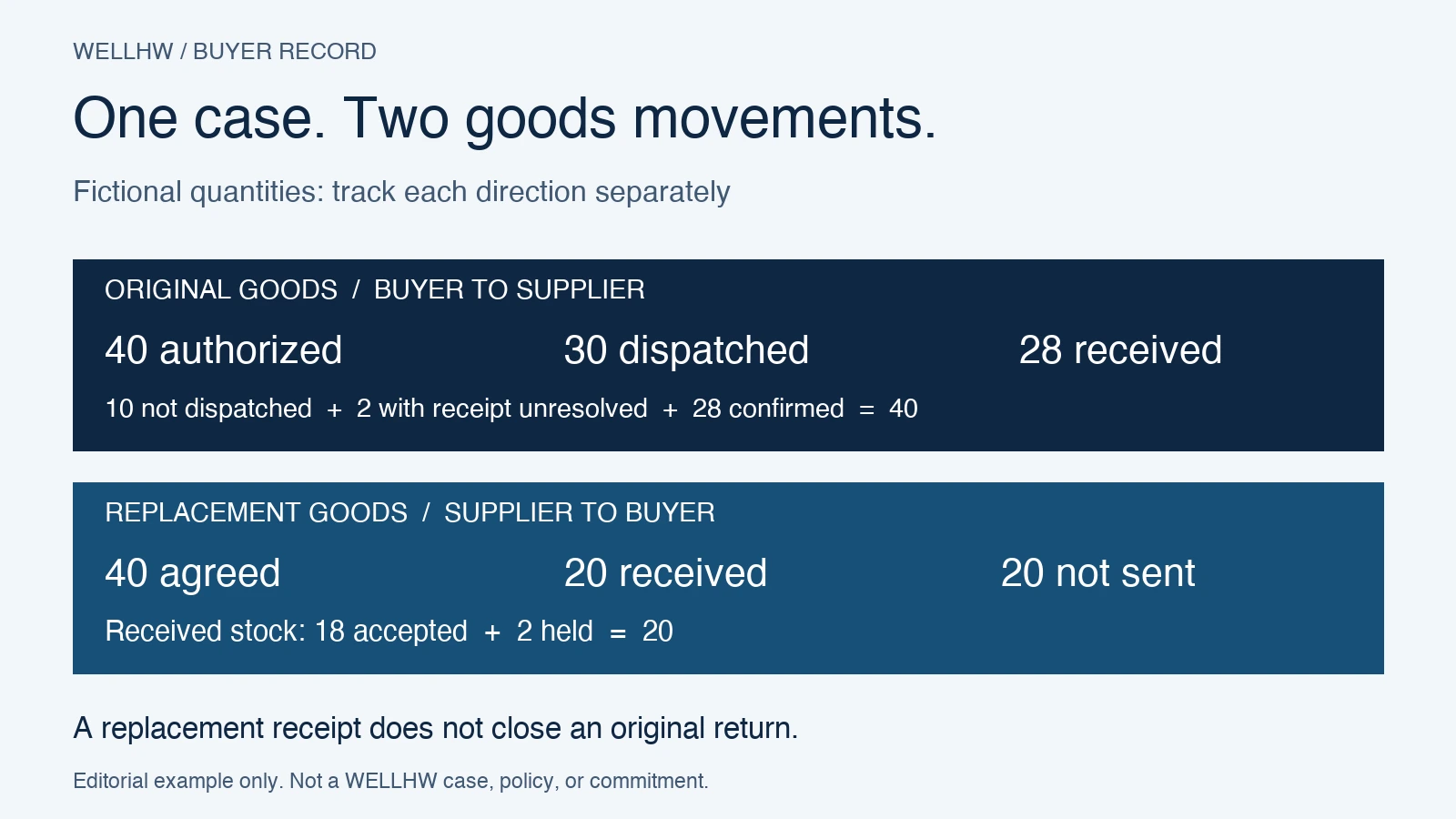
The buyer has also received 20 replacement sets. The applicable project review records 18 as accepted and two as held. The supplier has not yet dispatched the other 20 agreed replacements.
- Original goods: 28 supplier receipt-confirmed + 2 dispatched with receipt unresolved + 10 not dispatched = 40 sets.
- Replacement goods: 20 received + 20 not yet dispatched = 40 agreed sets.
- Received replacement stock: 18 accepted + 2 held = 20 physically received sets.
The original return still has 12 sets without confirmed supplier receipt, but the next actions differ: arrange the outward movement of ten and reconcile the evidence for two. Do not report all 12 as in transit. Likewise, the two held replacement sets are physically present and must not also be counted as missing from the replacement delivery.
Receiving 20 replacements does not reduce the original-return balance by 20. These are different goods moving in opposite directions. Keep the return, replacement, stock decision, and any separate investigation open for their actual unresolved scope.
Copyable Return and Replacement Record
Use one case header, then repeat the movement and receipt entries for every shipment. Update the summary at a stated cutoff without deleting earlier counts or source references.
1. Case and instructions
Case ID / owner / review cutoff: ____
Original PO / line / receipt or issue reference: ____
Original item / unit / lot and package references: ____
Return instruction / issuer / covered quantity / destination / conditions: ____
Requested remedy / actual agreement / unresolved scope: ____
2. Original-goods movement
Movement ID / item / unit / lot / packages: ____
Quantity dispatched / dispatch date / carrier reference: ____
Supplier receipt reference / date / quantity confirmed: ____
Count difference / supporting evidence / review owner: ____
Authorized quantity not dispatched / current location / next action: ____
3. Replacement movement and receipt
Agreement or order reference / line / approved scope: ____
Replacement item / unit / actual lot and package references: ____
Shipment reference / dispatched quantity / date: ____
Buyer receipt reference / received quantity / date: ____
Accepted / held / other recorded stock state and quantity: ____
Decision owner / evidence / remaining shipment or review action: ____
4. Closure by scope
Original-return reconciliation / remaining quantity / owner: ____
Replacement delivery and stock decisions / remaining action / owner: ____
Separate commercial action / authority and completion references: ____
Linked investigation / status / owner: ____
Scope closed / evidence / authorized owner / date: ____
Scope still open / next action / review date: ____
Keep confidential key identifiers, credentials, proprietary technical files, and payment details in authorized systems. Use controlled references and named owners in a broadly shared tracking record.
Close Each Action With Its Own Evidence
Before closing the return scope, reconcile the authorized original goods with outward movements, confirmed receipts, and any later authorized changes. Before closing the replacement scope, reconcile the agreed item and quantity with shipment, receipt, and stock-decision records. If one scope is complete while another remains open, state that boundary explicitly.
If a supplier corrective action record is required, retain its separate cause and effectiveness review. Neither a completed return nor a replacement delivery proves that the underlying issue has been resolved.
For a WELLHW order question, use the project inquiry route with your order and case references, item and unit, affected quantity, relevant instruction and movement references, and the exact unresolved question. Confirm case-specific instructions through the responsible contact before sending goods.
This AI-assisted article is an adaptable editorial tracking tool. The worksheet and quantities are not a WELLHW operating procedure, customer case, warranty policy, technical approval, or promise of a remedy.
