
A lock sample dispatch and receipt record connects a buyer’s sample request to the supplier’s identified items, each parcel, the carrier’s delivery event, and the buyer’s physical count. It answers a narrow question: which sample version is actually available for review, and which handoff is still unconfirmed? A tracking number or “delivered” notification does not itself identify the contents on the buyer’s workbench or approve a lock design.
Use this record before evaluating samples for a cabinet lock program, furniture project, locker order, mailbox application, or enclosure project. It is an adaptable buyer-side handoff tool. The parties’ own documents and authorized reviewers still decide technical suitability, sample acceptance, commercial terms, and production release.
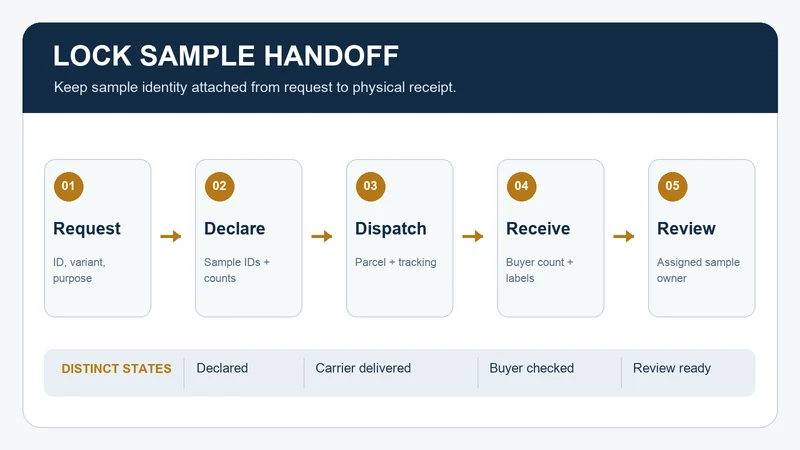
Start With the Request, Not the Tracking Number
Give the request an ID and identify the buyer item, supplier item reference, sample purpose, requested quantity, and document revision the buyer expects to review. Record who can confirm that scope on the buyer side and who will prepare the sample package on the supplier side. A sample request can contain more than one variant; assign a distinct sample ID or line to each one. Do not let a shared product name stand in for the version or the purpose of review.
The requested quantity is only the starting boundary. Record the supplier’s confirmed preparation quantity separately. If the supplier can prepare fewer samples or proposes a different revision, leave the difference open for the buyer owner instead of silently editing the original request. A line marked “prepared” is not yet evidence that a parcel was handed to a carrier.
Record What Was Dispatched in Each Parcel
For every parcel, record its package reference, sender’s dispatch date, carrier and tracking reference, declared sample IDs and quantities, and the supplier’s packing-list or message reference. If one request is split into two parcels, use two parcel rows. If two sample variants share a parcel, list both on that parcel’s contents line. A second buyer should be able to trace each physical sample ID to one declared parcel without guessing from the carrier label.
Microsoft Business Central’s posted shipment report is one software example that separates shipment and order references from item lines, quantities, and units of measure. This is not a statement that WELLHW uses Business Central or that a sample shipment must use its format. The practical lesson for the buyer record is to keep the line-level contents alongside the parcel-level tracking reference.
Use the supplier’s actual dispatch evidence, not only an estimated ship date. If the waybill was created but collection is unconfirmed, label that state clearly. Do not record a parcel as dispatched merely because a tracking number exists.
Separate Carrier Delivery From Buyer Receipt
Record the carrier’s latest status and evidence link in a carrier column. DHL’s shipping FAQ says tracking can show delivery information and, for eligible DHL Express shipments, a proof-of-delivery document may be available. That evidence can help locate a parcel, but the buyer still needs an internal receiving record to establish which sample IDs and quantities were physically found.
At the buyer location, record who opened or counted the parcel, when, the package reference used, the observed sample labels, and the observed quantities. Keep three events distinct: carrier reports delivered, buyer has located the parcel, and buyer has checked its contents. Microsoft Supply Chain Management also distinguishes preregistration, arrival registration, and product receipt in its purchase-order receiving workflow; that is a software example of why an advance notice and a completed receipt should not be conflated.
Record a visible packaging or labeling discrepancy as an observation with a photo or document reference, not as a proven cause or transport claim. If the recipient is someone other than the sample reviewer, identify the handoff to that reviewer separately. Physical receipt is not evaluation, and evaluation is not approval.
Route Gaps Without Guessing Where a Sample Is
| Record shows | Keep this state | Next owner action |
|---|---|---|
| Tracking number issued; no handoff evidence | Waybill created; dispatch unconfirmed | Ask the sender for collection or handoff evidence and the parcel contents reference. |
| Carrier marks delivered; buyer cannot locate parcel | Carrier delivered; buyer receipt open | Use the delivery evidence and local receiving contact to locate the parcel before counting samples. |
| Parcel found; sample count differs from declaration | Physical receipt recorded with an open quantity difference | Retain the packing list and observed count, then ask the responsible owner to reconcile the difference. |
| Count matches; revision label or sample ID does not | Identity unresolved; evaluation not assigned | Request the supplier’s declared sample reference and have the buyer owner confirm which version should be reviewed. |
These are suggested record states, not a universal shipping or warranty policy. Name the person who owns each open question and the evidence needed to move it. Do not convert an unresolved count or label into a technical reject or a claim against the carrier.
Fictional Example: Two Parcels, One Review Still Open
Fictional administrative example. A buyer requests four evaluation samples under request R-24: two labeled A-02 and two labeled B-02. The supplier reports that parcel P-1 contains the two A-02 samples and parcel P-2 contains the two B-02 samples. Both parcels receive separate tracking references.
The carrier later reports both parcels delivered. The buyer’s receiving team physically finds and counts P-1: two A-02 units. P-2 has not yet been located inside the buyer organization. The record therefore says: requested four; supplier-declared dispatched four across two parcels; carrier-delivered parcels two; buyer-counted samples two; P-2 buyer receipt open. It does not say that two samples are lost, that B-02 was never shipped, or that the A-02 samples passed evaluation.
The receiving owner checks the carrier delivery detail and the site’s receiving desk. When P-2 is found, the buyer records its observed labels and quantity as a new receipt event. Only then can the evaluation owner confirm that the intended B-02 version is ready for review. All IDs and events are invented; they are not a WELLHW shipment or delivery result.
Copyable Sample Dispatch and Receipt Record
Use one request header, a row for each sample variant, and a row for each parcel and receipt event. If a field is unknown, write “unknown,” assign an owner, and identify the next check. Keep personal addresses, sensitive key information, credentials, and facility access details in the authorized logistics channel rather than a broadly shared sample log.
Request and declared sample lines
Request ID / buyer project and item / supplier reference ____
Sample purpose and governing document revision ____
Sample ID or variant / requested quantity and unit ____
Supplier-confirmed preparation quantity / difference or proposal ____
Buyer request owner / supplier preparation contact ____
Repeat for each parcel
Parcel ID / declared sample IDs, revision labels, and quantities ____
Packing-list or dispatch-message reference and date ____
Carrier / tracking reference / waybill-created date ____
Actual carrier handoff evidence and dispatch date ____
Carrier latest event / proof-of-delivery reference, if available ____
Repeat for each buyer receipt or handoff
Parcel located by / location / date ____
Contents checked by / date / observed labels and quantities ____
Declared-versus-observed difference and evidence ____
Current owner / open question / next check ____
Sample evaluation recipient / physical handoff date ____
Related feedback or approval record ID, when later created ____
Before closing the dispatch and receipt record, ask whether every declared sample line can be matched to a checked physical unit or an explicitly open exception. A second buyer should be able to find the parcel, the original declaration, the observed count, and the next owner without relying on a chat memory.
Hand the Right Sample Into Review
Once the intended sample ID and revision are physically accounted for, pass its reference to the sample feedback log for reviewer comments. A later approved reference belongs in the approved-sample retention record. If the project requires a separate first-article decision, use the first-article inspection record. The dispatch and receipt log closes a logistics and identity handoff, not any of those technical decisions.
For a WELLHW sample inquiry, send the request ID, buyer and supplier item references, sample IDs or revisions expected, declared parcel contents, available tracking references, buyer-observed counts, and the precise unresolved question. Name the buyer contact who can confirm the review scope. Send the scoped sample question to WELLHW.
The states, exception table, fictional example, and worksheet are adaptable editorial tools. Apply the actual project agreement and authorization rules.
