
A lock mounted on one door of a two-door cabinet is only part of the closure. The engineering question is how the complete door set is restrained: where each leaf engages, what it engages with, and how that engagement connects to the cabinet structure.
For metal-cabinet manufacturers and hardware buyers, start with the closed-door section and the intended operating sequence. Those two records are more useful than a list of “best” locks. This guide explains three closure arrangements and shows how to turn the selected arrangement into a drawing and sample review.
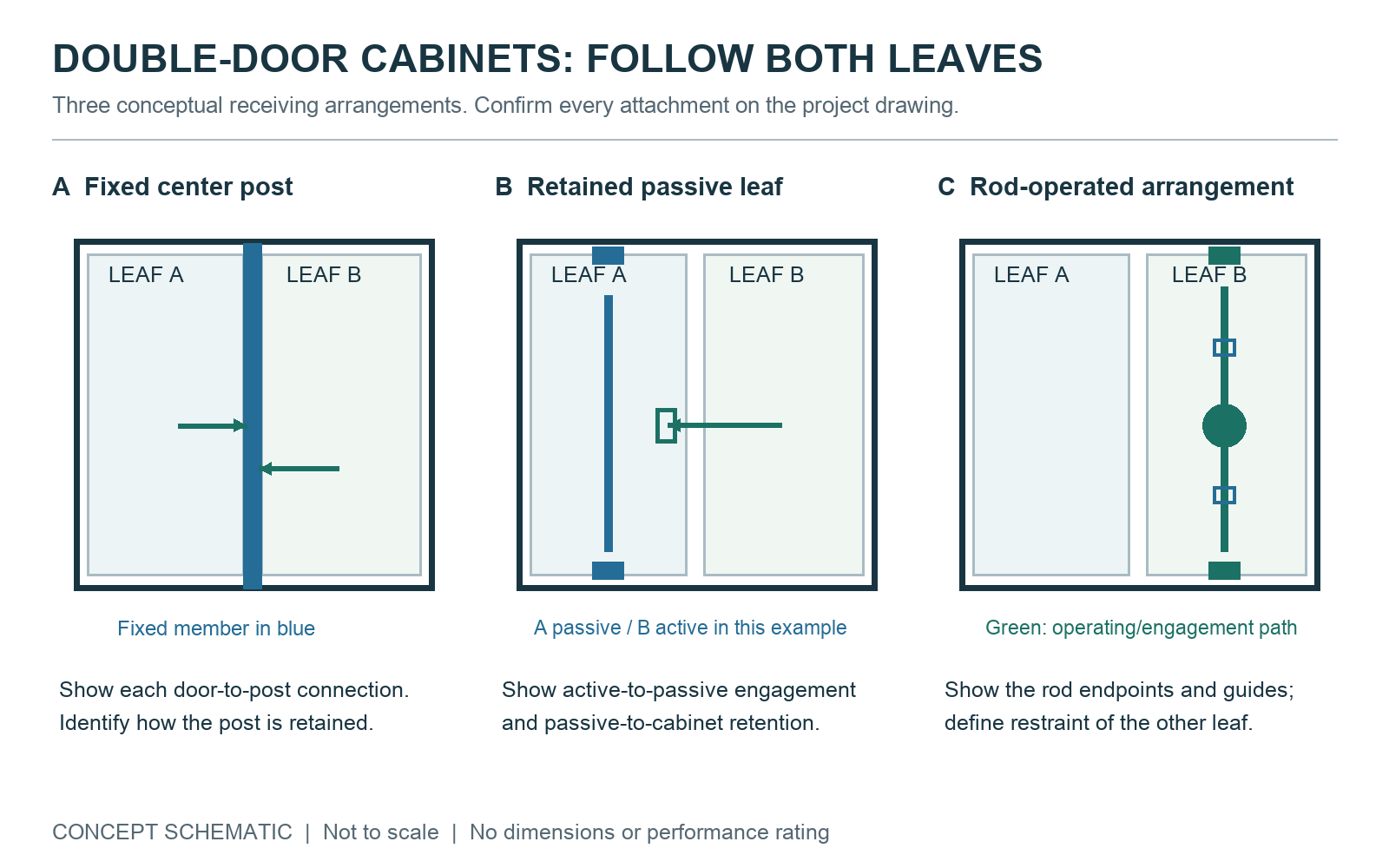
Start by identifying the receiving structure
Call the doors leaf A and leaf B on the drawing, and identify the viewing side. If the design has an active leaf, define it as the door normally operated first for access. If another leaf normally stays secured until the active leaf is opened, identify it as the passive leaf. Do not assign these roles merely from which side carries the handle.
Next, mark every receiver: the surface, keeper, socket, or bracket that a cam, bolt, or rod engages. A receiver on a fixed cabinet member has a different structural connection from one attached to another moving door. Trace that connection before choosing the hardware family.
The result should be an annotated assembly view, not just a front photograph of a cylinder. For example, Artcobell’s cabinet-door instructions illustrate a particular cam engaging behind a center post. That is an example of a defined receiving structure, not a universal arrangement for every double-door cabinet.
Three arrangements to compare on the cabinet drawing
A fixed center post receives the locking elements
A center post, or mullion, is a cabinet member between the two leaves. In an arrangement that uses it as a receiver, the engagement from each relevant door can be shown against that fixed member. The drawing still needs to show whether both leaves have independent locks or whether another retaining arrangement is used.
This layout makes the center member part of the access-opening decision as well as the locking decision. Ask whether the usable opening meets the product’s loading and servicing requirements. A removable post introduces another connection that must be identified and reviewed; the word “mullion” alone does not establish how it is secured.
The active leaf engages a retained passive leaf
Where the opening has no fixed center post, the active leaf may engage a keeper or formed edge on the passive leaf. In that arrangement, document how the passive leaf is retained to the cabinet. The conceptual connection is active leaf → receiving hardware on passive leaf → passive-leaf retaining hardware → cabinet structure.
This is a load-path description, not a strength rating. Each attachment and receiving surface remains part of the engineering review. Naming only the active-leaf lock leaves the passive-leaf hardware outside the purchasing specification.
If the meeting edges overlap, record the intended closing order and confirm it on the authorized sample. Include the overlap detail in the section view so the reviewer can check the selected sequence and hardware positions together.
Rods connect the operating mechanism to several receivers
A rod-operated arrangement can place engagement points away from the operating handle. Lowe & Fletcher’s enclosure accessory documentation describes rods above and below an operating mechanism and associated guides and cams. Such a system is an assembly of interacting parts; selecting its handle alone does not define the closure.
On your drawing, identify which leaf carries the mechanism, where the rods terminate, and what restrains the other leaf. Ask for the rod guides, receivers, and any intermediate components to be included in the reviewed configuration. The number of engagement points does not by itself establish the completed cabinet’s performance.
Read the meeting edge in section
The meeting edge is where the two doors approach or overlap. A front view can show the handle position while concealing the geometry that decides engagement. Add a section through the actual lock point, including the formed door edges, keeper, reinforcement, and relevant cabinet member.
Separate three questions. Reach asks whether the locking element reaches the intended receiving region. Depth and offset describe where that element sits through the assembly. Travel clearance concerns the full movement between its end positions. One dimension or product photograph cannot answer all three.
Ask the designer to mark the reference surfaces for the closed gap and any overlap. Use the project’s approved values and tolerances. This article supplies no universal gap, engagement depth, panel thickness, or tightening value.
For the detailed movement of a rotary cam, use the separate cam travel and frame-engagement explanation. Keep this double-door review focused on how the two leaves form one closure.
Compare complete arrangements, not isolated lock prices
| Arrangement under review | Required decision | Items to include in the comparison |
|---|---|---|
| Engagement with a center post | How are both leaves restrained, and is the post fixed or removable? | Each lock or retainer, receivers, post connections, and opening requirements. |
| Engagement between leaves | How is the passive leaf retained, and is a closing order required? | Active lock, meeting-edge receiver, passive-leaf retainers, and attachments. |
| Rod-operated closure | Which engagement points and door roles are included? | Operating mechanism, rods, guides, receivers, connections, and the other leaf’s restraint. |
Use this comparison before asking for unit prices. State whether the quoted unit is one lock, one door’s hardware, or a complete cabinet door-set kit. A quotation that omits the passive-leaf hardware is not directly comparable with a complete-set quotation.
Review normal operation on the complete sample
Use an authorized development cabinet and its assigned credential under an agreed safe review procedure. Record the sample and drawing revisions before observing operation. Do not substitute forced operation or a security test for this fit and function review.
Observe the specified sequence from both leaves open to the intended closed and locked state. Record the final position of both leaves and all specified engagement points. Then observe normal unlocking and opening in the intended order. If one leaf has an independent service-opening mode, review that mode separately.
Keep observations distinct from diagnoses. “The passive leaf did not reach the position shown on section B–B” identifies a discrepancy. “Use a stronger lock” proposes a solution without establishing the cause. Send the marked view, sample identity, and observed condition to the responsible engineer before accepting a component change.
A hypothetical example illustrates the distinction: the lock and cam remain unchanged, but a revised door drawing moves the receiver. The previous lock approval no longer answers the revised engagement question. Compare the new section and sample against the original acceptance criteria before releasing that configuration.
What to send with a double-door cabinet lock inquiry
Prepare a front view with the viewing side and door roles marked, a section at each engagement point, the intended opening and closing sequence, and a list of the hardware included per cabinet. Add application conditions, quantities, finish requirements, and the sample-review owner. Mark unknown values as questions for engineering review.
The cabinet lock catalog can help identify items for discussion. Send the complete door-set information through the WELLHW project contact page; a listed lock should not be treated as an approved solution for a double-door assembly without reviewing its actual configuration.
