
Before a B2B lock order’s shipment paperwork is handed to a freight or import team, compare the approved order or order confirmation, commercial invoice and packing list as one set. A matching invoice total alone does not show which lock items are in which cartons. A matching carton count alone does not show whether every invoiced item is covered. This buyer-side cross-check keeps those questions visible and gives the supplier a precise correction request.
The Government of Canada’s export documentation checklist calls for consistency across buyer details, product descriptions, quantities, prices, terms, and packing information. The method below turns that general guidance into a working record for lock orders. It is a document comparison tool, not a determination of customs requirements or permission to ship.
Start with the approved order and the exact document versions
Use the latest approved purchase order and any accepted amendment or order confirmation as the commercial reference. Note the invoice number and revision or issue date, and the packing list number and revision or issue date. If the supplier has sent replacements, mark earlier copies superseded so a forwarder is not handed two competing versions. The purchase order acknowledgment check addresses the earlier decision about what the supplier accepted; this review compares the shipment documents against that accepted scope.
For a partial shipment, record the shipment reference and the order balance expected after this shipment. Do not assume the invoice or packing list must equal the entire order quantity. Ask the supplier to identify which order lines and delivery batch the documents cover.
Compare transaction fields before item lines
First compare the commercial invoice with the approved order or confirmation: buyer and seller identities, ship-to or consignee reference where applicable, purchase order reference, currency, item descriptions, unit prices, extended totals, and agreed commercial terms. Keep a separate note for any difference that is intentional and documented, such as an accepted price amendment. A document match does not itself establish that a term, valuation, or declaration is legally correct.
Then check the shared identifiers on the packing list: invoice or order reference, shipment reference, consignee, item names or SKUs, and total units. The U.S. International Trade Administration’s export document guidance describes a packing list as a document that itemizes goods by packages, including quantities, descriptions, package count, marks, weights, and dimensions where appropriate. Confirm which fields the actual buyer, carrier, and import process require rather than treating one example as a universal form.
Reconcile quantities in both directions
Build one row per shipped lock item or SKU. Compare the approved shipment quantity, invoiced quantity, and sum of that item’s quantities across every packing-list carton. Where a unit pack contains accessories or keys, identify whether those are part of the SKU or separate line items in the agreed order. Do not infer a missing item from a short description alone; ask for the controlled item reference used by both parties. Keep sensitive key codes or access details out of a broadly shared shipping worksheet.
| Level | Compare | If it differs |
|---|---|---|
| Transaction | Order, invoice, and packing-list references; parties and agreed destination | Identify the source document and ask for a corrected reference or documented amendment. |
| Item | SKU/description and shipped quantity against invoice and carton totals | Name the exact item and the three quantities; request a corrected line or carton map. |
| Package | Carton ID, item contents, units per carton, package count, and applicable weight/dimension totals | Request a revised carton line and verify the corresponding invoice item total. |
Run the check in both directions: every invoice line should map to packing-list contents, and every packed item should map to an invoiced or otherwise explicitly documented line. Record an unexplained extra carton or item as an exception even when grand totals happen to match. For a quality and physical shipment release decision, use a separate pre-shipment release record; paperwork agreement cannot establish product conformity.
Trace carton totals without losing the item identity
For each carton ID, add the quantities of its listed items. Then sum carton quantities by SKU, not only by shipment. This catches a swapped allocation: the overall unit count may be correct while one lock type is short and another is over. Compare the stated number of cartons with the unique carton IDs and any label or transport reference supplied. If weights or dimensions are part of the agreed document set, compare their stated units and totals too; do not invent missing measurements.
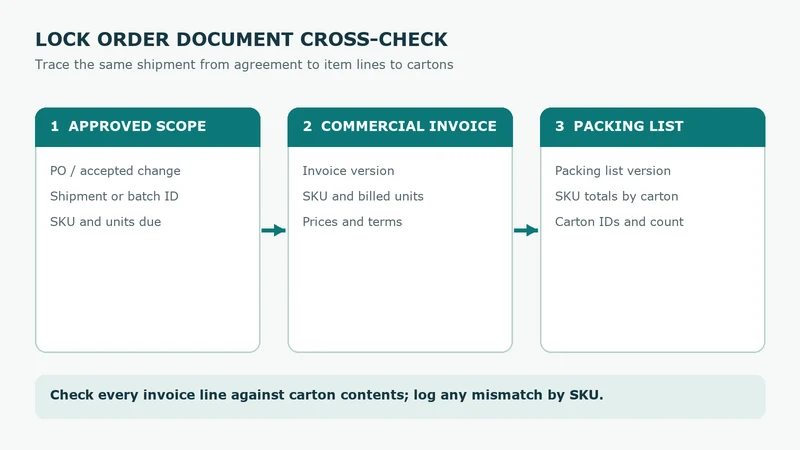
Editorial diagram: trace each item from the approved shipment scope through invoice lines to the cartons listed for that shipment.
A fictional mismatch: the total is right, the mix is wrong
Consider a fictional shipment with 120 units of SKU CL-A and 80 units of SKU DL-B in the accepted shipment scope. The invoice lists the same 120 and 80. The packing list totals 200 units, but its carton lines add up to 110 CL-A and 90 DL-B. The shipment-wide total agrees; the SKU mix does not. The buyer should record the two line differences, ask the supplier to verify the carton contents and issue a corrected packing list or explain an approved change, and keep the current file marked open. The example is arithmetic only; it is not a WELLHW shipment, inspection result, or claim about actual goods.
If the physical contents differ from the documents, the responsible team must resolve that operational issue under the project’s release process. A paperwork edit should not be used to hide a physical discrepancy. If the mismatch is discovered after receipt, track it in the receiving discrepancy record.
Copyable invoice and packing-list exception record
Use one row per mismatch. Attach or privately reference the source versions so the reviewer can reproduce the comparison. Close the row only after the corrected document or approved explanation has been checked against the same order baseline.
| Field | Entry |
|---|---|
| Order / shipment | PO number and revision; shipment or delivery-batch reference |
| Documents compared | Invoice number, date, version; packing-list number, date, version |
| Affected line / carton | SKU or controlled item ID; carton ID(s), if relevant |
| Values compared | Approved shipment quantity; invoice quantity; packed quantity; package count or other field |
| Difference and source | Exact mismatch, which document states each value, and any amendment reference |
| Owner and action | Who verifies physical contents or corrects the document; requested response and due date |
| Disposition | Open / corrected and rechecked / approved explanation / escalated |
| Handoff | Final document versions, checker, date, recipient and superseded-copy location |
For a clean handoff, identify the single current invoice and packing list, close or explicitly escalate every exception, and send the final versions to the agreed document recipient. Ask the freight or customs specialist to confirm any destination-specific form, classification, origin, valuation, or filing requirement. The cross-check shows internal consistency; it does not replace that specialist review.
For a lock order inquiry, send WELLHW the purchase order and shipment references, affected item or carton IDs, the invoice and packing-list versions, and a concise description of the discrepancy through the agreed private channel. Send the document question to WELLHW.
