
A padlock hasp forms a connection between a movable closure and its receiving point, with a padlock used to secure the intended assembly. For a cabinet or enclosure buyer, the selection problem is the complete pair: the hasp must suit the door geometry, and the padlock must fit and operate in that installed position.
This guide explains the interfaces to review before ordering. It does not assign a security rating from appearance or recommend a universally “best” hasp. Use the selected manufacturers’ drawings and approved application requirements to define the actual combination.
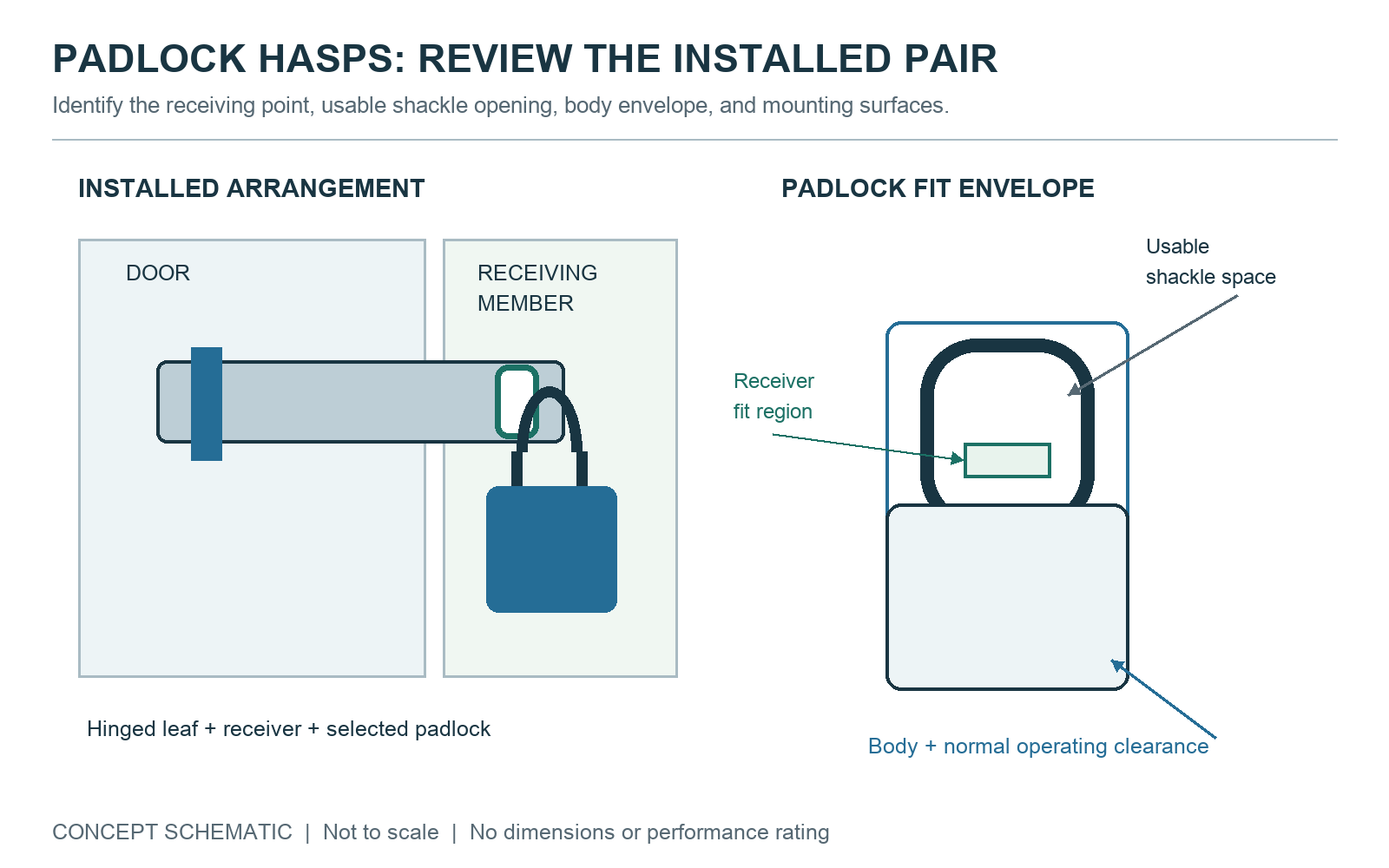
Identify the parts before comparing product names
In a common hasp-and-staple arrangement, a hinged leaf closes over a staple or receiving loop, and the padlock secures the intended connection. Product names vary, so request an assembly drawing that identifies the supplied parts and how they mount.
Do not assume that “hasp lock,” “padlockable latch,” and “hasp and staple” describe the same purchase unit. Some products incorporate a keyed mechanism; others require a separate padlock. Record whether the quotation includes the receiving component, mounting hardware, and padlock.
The distinction matters in WELLHW inquiries as well. The catalog lists a keyed hasp lock and a padlockable cam lock. Those listings identify different items for discussion. They do not establish that either is interchangeable with an external hasp-and-staple assembly.
Review the closed-door geometry first
Show the closed door and receiving member in section. Identify whether their mounting faces are level, offset, overlapping, or separated by a formed edge. Then place the proposed hasp and receiving part on that drawing using their actual mounting references.
A hasp intended for level faces should not be treated as a match for a stepped joint merely because its overall length looks sufficient. The hinge movement, leaf position, and receiver must be checked together. Where adjustment or a spacer is proposed, obtain a reviewed detail rather than improvising one during assembly.
As a specific manufacturer example, ABUS identifies its 130 hasp for flush-closing doors and names a corresponding padlock pairing. That example shows the importance of both door geometry and the selected combination. Its product claims and dimensions are not WELLHW specifications.
Match more than shackle diameter
The shackle is the padlock’s movable locking loop. Its diameter is only one part of the fit review. The usable internal opening, the receiver’s shape and position, the padlock body, and the normal opening movement all need room in the installed assembly.
Request the padlock drawing and the hasp drawing together. Mark the receiver within the usable shackle opening, then check where the body sits relative to the door, frame, hinge, and surrounding components. Include space for normal key access or the selected authorized operating interface.
Finally, review the normal open-to-closed sequence on an authorized sample. A combination that can be placed together on a bench may be inconvenient or incompatible when mounted at the intended location. Record the specific interference or operating restriction; do not infer the cause from the padlock’s advertised size.
What to check when an offer says “shrouded”
Ask the supplier to identify the component described by that word. It may describe a cover around the receiving area, a padlock body that surrounds part of its shackle, or another model-specific feature. A drawing is more informative than treating the term as a universal category or a rating.
For an open hasp-and-staple arrangement, mark the receiver and selected padlock directly on the assembly view. For an arrangement with a surrounding cover, add the cover’s internal space and normal operating path. Check the exact intended pair rather than assuming that a padlock that fits the uncovered receiver also fits the covered assembly.
| Review item | Open receiving arrangement | Arrangement with a cover or shroud |
|---|---|---|
| Padlock fit | Check the receiver within the usable shackle opening and locate the body. | Also check the body’s and shackle’s relationship to the surrounding enclosure. |
| Normal operation | Observe the specified locking and unlocking movement at the installed location. | Check access and movement within the actual covered configuration. |
| Drawing evidence | Obtain hasp, receiver, padlock, and mounting references. | Include the cover and its connection to the mounting assembly. |
| Performance statement | Request evidence for any required rating or test. | Request evidence for that exact claim; the word “shrouded” does not supply a rating. |
This comparison addresses fit and documentation. It does not establish that one untested arrangement is more secure than another, and it provides no attack or bypass methods.
Include the mounting connection in the specification
The hasp, receiver, fasteners, and mounting material form an assembly. A product material label does not establish the performance of that entire connection. Ask the responsible engineer to define the fastening arrangement, any backing or reinforcement, and the application requirements that need verification.
Keep material and finish requirements separate from unsupported promises such as “weatherproof” or “rustproof.” State the intended exposure and any required test or approval reference, then request evidence for the offered configuration. Do not assign a test duration or material grade from a photograph.
For a double-door cabinet, also identify which leaf carries each component and how the other leaf is restrained. The double-door cabinet lock review addresses the complete door-set question.
Approve the pair as one controlled configuration
Retain the hasp and receiver references, padlock model, mounting drawing, installed sample identity, and required normal operating sequence. Record what was checked, the acceptance criteria used, unresolved questions, and the review decision.
For example, consider a hypothetical order in which a distributor proposes another padlock with the same nominal shackle diameter. That single shared dimension does not document the same usable opening or body envelope. Request the replacement drawing and repeat the affected fit review before accepting it as an equivalent.
Send the application, closed-door section, proposed hasp and padlock references, mounting details, and quantities through the WELLHW project contact page. Clearly identify whether the inquiry concerns an integrated keyed hasp, an external padlock arrangement, or a padlockable cam latch so the correct item can be discussed.
